
Sleep Problems & Disorders
Insufficient sleep syndrome
Insufficient sleep syndrome occurs when a person regularly gets less sleep than their body needs, leading to daytime sleepiness, reduced alertness, and difficulty functioning. It is not the same as one short night of sleep, and it is not a character flaw. It is a pattern of sleep loss that can build over time and it affects whole-person health.
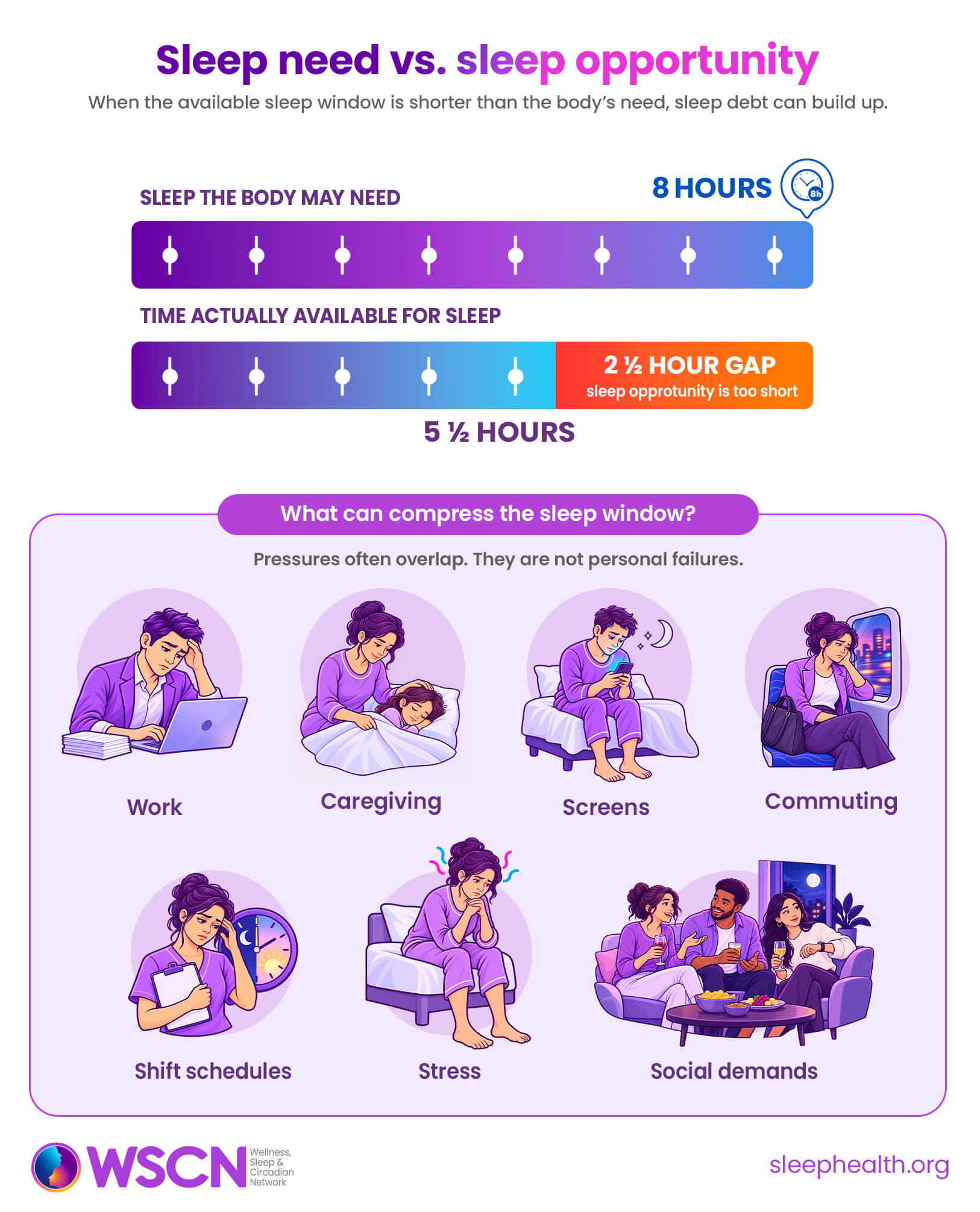
Adults may lose sleep because of work, caregiving, school, social demands, long commutes, digital media, irregular schedules, or other responsibilities. At other times environmental and socioeconomic barriers may exist for people to get enough sleep. Some people do not realize how much sleep they need until they have the chance to sleep longer and their daytime symptoms improve.
Overview
- Insufficient sleep syndrome is a sleep-wake disorder caused by regularly not allowing enough time for sleep
- The main symptom is daytime sleepiness or reduced alertness that improves when sleep time is extended
- Adults may not recognize the pattern because short sleep can become normalized
- Some cultures promote hustle culture, or the idea of “not needing” much sleep, which can lead people to deprioritize sleep in harmful ways
- Sleep loss can affect concentration, mood, decision-making, safety, metabolism, and whole-body health
- Diagnosis often uses sleep history, sleep diary, actigraphy, and evaluation for other sleep or medical conditions
- Treatment focuses on increasing sleep opportunity, making schedules more regular, and addressing barriers that keep sleep too short
About insufficient sleep syndrome
Insufficient sleep syndrome is a clinical sleep disorder in which a person regularly sleeps less than needed. In sleep medicine classifications, it is grouped among central disorders of hypersomnolence because the main presenting problem is often excessive daytime sleepiness. But there is a key difference: in insufficient sleep syndrome the cause is usually behavioural or external (such as schedules and obligations).
For many adults, insufficient sleep develops gradually. A person may shorten sleep to meet work, family, school, financial, social, or caregiving demands. Others may delay bedtime because of media use, unfinished tasks, or social activities. Over time, the body accumulates a sleep debt.
A key feature of insufficient sleep syndrome is that symptoms improve when the person consistently sleeps longer, with consistent timing and regularity.
Circadian timing also matters. The body clock helps organize sleep, alertness, digestion, temperature, hormones, and performance across the day. Short sleep combined with irregular schedules, late-night digital media, and large weekend sleep-ins can make sleep timing less stable and add to symptoms. Improving the circadian rhythm can help stablize sleep patterns.
The key is not to blame a person for not sleeping enough. There are often strong work and family pressures – along with cultural beliefs about sleep – that contribute to insufficient sleep syndrome. Research suggests that a whole-person approach is important in treatment – including sleep health education and lifestyle support.
Signs and symptoms
Insufficient sleep syndrome is often caused by responsibilities and pressures across all 24 hours, and it can affect the whole 24 hours in return as sleep debt rises and starts to impact daytime wellbeing.
Nighttime and schedule patterns
A person may:
- Routinely spend too little time in bed to meet their sleep need
- Go to bed later than intended
- Wake early for work, caregiving, school, or responsibilities
- Sleep longer on days off
- Use weekends or vacations to “catch up”
- Nap because of sleepiness
- Have a large difference between workday and free-day sleep timing
Daytime symptoms
Daytime effects may include:
- Sleepiness or dozing during quiet activities
- Fatigue or low energy
- Reduced alertness, memory and concentration
- Irritability or lower mood
- Reduced motivation or productivity
- Headaches or physical heaviness
- Increased caffeine use
- Drowsy driving or safety concerns
Screening and diagnosis
A clinician may evaluate insufficient sleep syndrome when an adult reports daytime sleepiness, fatigue, reduced alertness, or difficulty functioning and has a pattern of short sleep. Information that may help a clinician make a diagnosis includes:
- Sleep and wake history for workdays and days off
- Sleep diary for one to two weeks or longer
- Actigraphy, a wrist-worn monitor that measures sleep, rest and activity patterns
- Review of work schedule, caregiving responsibilities, commute, and naps
- Frequency, timing, and amount of medications and other substances, including caffeine, nicotine, and alcohol
Clinicians can usually diagnose insufficient sleep syndrome by taking a detailed sleep history and looking at pressures in a person’s life that may affect sleep opportunity. However, in some cases, a doctor may order additional testing to rule out other sleep disorders. Learn more about diagnosing sleep disorders.
A sleep diary and actigraphy can be especially useful because it shows whether the person’s sleep opportunity is consistently shorter than their likely sleep need. Completing a trial of extending time in bed and making sleep timing more regular helps clarify whether symptoms improve.
When to talk with a healthcare professional
A person does not need to know the name or exact nature of a condition before asking for help. If a person experiences any of the symptoms above, it is appropriate to discuss them with a healthcare professional.
Red Flag: Seek urgent medical care if symptoms or sleep loss are affecting a person’s ability to drive or work safely, or is causing severe distress or thoughts of self-harm.
What to bring to a doctor’s visit
A primary care physician is a good place to start for a sleep disorder evaluation. They can conduct preliminary screenings and recommend next steps for diagnosis. It can be helpful to bring information to an initial visit: try using WSCN’s How to talk to your primary care clinician about sleep problems checklist.
Causes, risk factors and health implications
Causes and risk factors
Insufficient sleep syndrome often reflects a mismatch between sleep needs and real-world demands. Common contributors include:
- Work and schedule pressures: long work hours, early start times, multiple jobs, shift work, and travel
- Caregiving and household demands: infant care, elder care, family responsibilities, household labor
- Behavioral factors: late-night media use, social activities, evening blue light, or lack of a consistent wind-down routine.
- Environmental factors: noise, temperature, bright nighttime light exposure
- Beliefs and stress patterns: feeling that sleep is optional, needing late-night time alone, worry, overcommitment, or difficulty setting boundaries around rest
- Health factors: pain, preexisting health conditions and medications
- Substance use: caffeine, nicotine, alcohol and marijuana all impact sleep quality and quantity much more significantly than people realise
- Circadian factors: irregular sleep timing, delayed sleep schedule, shift work, jet lag, or inconsistent light exposure.
These contributors are not personal failures. Identifying them helps guide a practical plan for how to optimize sleep and circadian health across all 24 hours.
Long-term health implications
When insufficient sleep continues untreated, it may contribute to or worsen several areas of health:
- Heart and blood vessel health: Short sleep has been associated with higher risk of hypertension and cardiovascular disease.
- Metabolic health: Insufficient sleep can affect glucose regulation, insulin sensitivity, appetite regulation, and weight-related health risks. It also increases risk for type 2 diabetes.
- Mental health: Ongoing sleep loss can worsen irritability, anxiety, low mood, emotional regulation, and stress resilience.
- Brain and cognitive health: Short sleep can impair attention, memory, reaction time, learning, and decision-making.
- Safety: Sleepiness increases risk for drowsy driving, workplace errors, injuries, and accidents.
- Immune and whole-body health: Sleep loss may affect immune function, inflammation, recovery, and the ability to maintain health-supporting routines like exercise and healthy eating.
- Relationships and quality of life: Chronic sleep loss can affect communication, patience, intimacy, social participation, and caregiving capacity.
These associations do not mean insufficient sleep causes every condition in every person. They do mean that persistent short sleep deserves attention as part of a whole-person, 24-hour approach to health.
Treatment and management
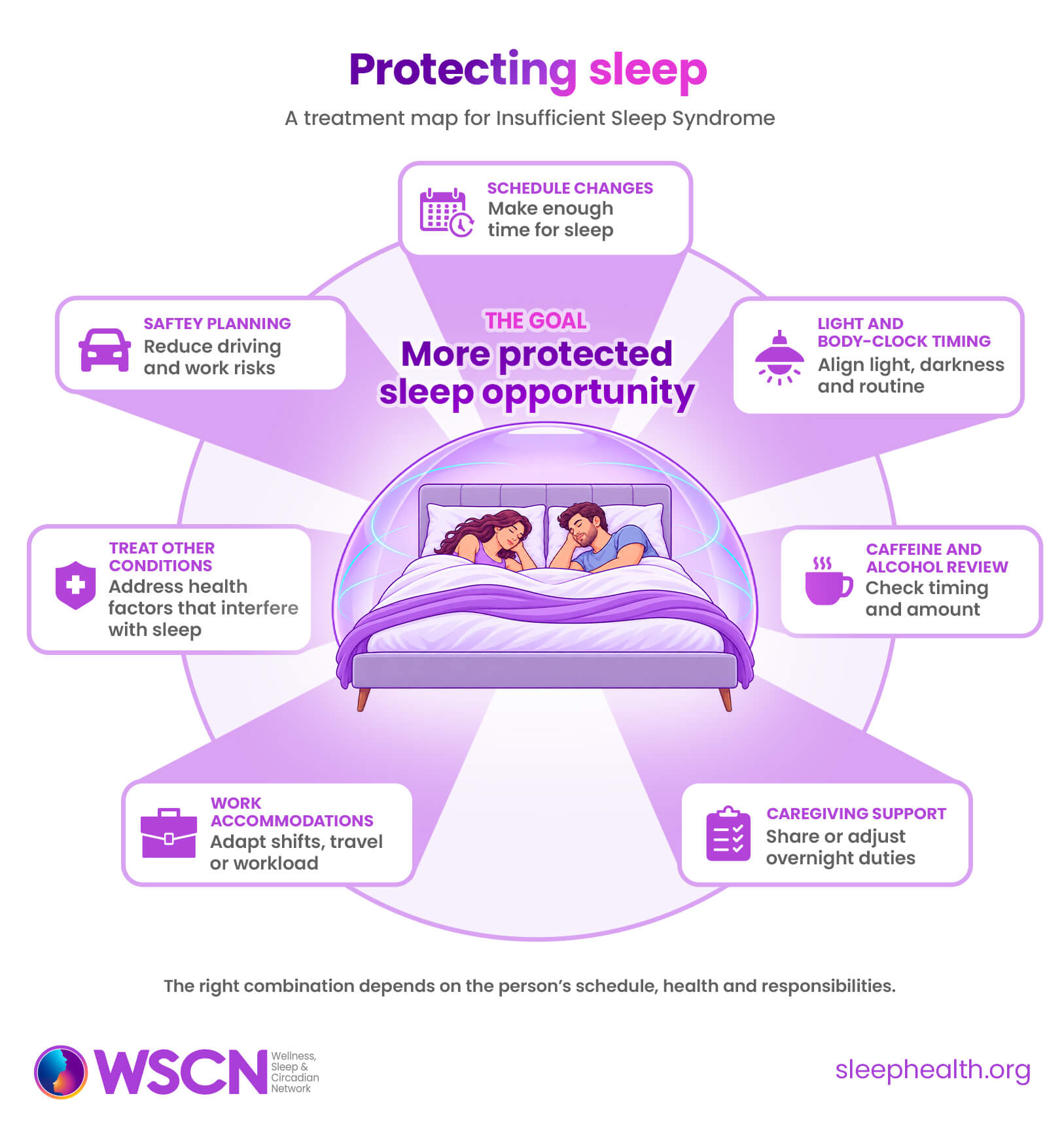
Treatment focuses on increasing sleep opportunity, improving sleep regularity, and reducing the barriers that keep sleep too short.
Extend sleep opportunity
The core treatment is to create enough protected time for sleep on a consistent basis.
A practical plan may include:
- Setting a realistic target sleep window
- Keeping a consistent wake time when possible, even on days off
- Talking to household members about your sleep goals and needs
- Asking for support with caregiving or household routines
- Addressing work schedule barriers when possible
- Moving bedtime earlier in small steps
- Reducing activities that delay sleep
Make the 24-hour routine support sleep
Sleep is easier to protect when the daytime routine supports it. Helpful strategies may include:
- Morning daylight exposure
- Regularly timed meals
- Physical activity earlier in the day
- Limiting alcohol late in the evening
- Avoiding caffeine 5-6 hours before sleep
- Reducing evening light exposure
- Creating a predictable, calming wind-down routine
Naps may help short-term safety and alertness, but long or late naps can make nighttime sleep harder for some people. Nap timing should be individualized.
Address related conditions and circumstances
If short sleep occurs alongside another sleep disorder, chronic pain, mental health disorders, or or medical conditions, treating these conditions may help protect sleep opportunity.
People living with chronic sleep loss may also need practical support to allow sufficient time for sleep. This may include discussing schedule changes, workload, caregiving help, transportation safety, or workplace accommodations.
Research and what we are still learning
Insufficient sleep syndrome is common but still under-recognized, perhaps in part because many cultures still undervalue the importance of sleep to overall health. Researchers are studying how to diagnose insufficient sleep syndrome more consistently, how sleep extension changes symptoms, and the best way to address barriers to getting adequate sleep.
Recent clinical research suggests that remission may depend not only on longer sleep time but also on more stable circadian rhythms including regular sleep schedules, fewer naps, and healthy daytime behaviors that support sleep.
The importance of sleep for general health has also been increasingly acknowledged by policy makers and the general public. Recent discussions around daylight savings time, high school start times, and workplace schedule flexibility all reflect a growing recognition of the importance of sleep.
Related conditions
Insufficient sleep syndrome can overlap with or be confused with:
- Insomnia disorder
- Obstructive sleep apnea
- Idiopathic hypersomnia
- Narcolepsy
- Circadian rhythm sleep-wake disorders
- Shift work disorder
- Depression, anxiety, pain, and medication-related sleepiness
American Academy of Sleep Medicine. (2020). Insufficient sleep syndrome. Sleep Education. https://sleepeducation.org/sleep-disorders/insufficient-sleep-syndrome/
Consensus Conference Panel, Watson, N. F., Badr, M. S., et al. (2015). Recommended amount of sleep for a healthy adult: A joint consensus statement of the American Academy of Sleep Medicine and Sleep Research Society. Sleep, 38(6), 843–844. https://doi.org/10.5665/sleep.4716
De Pieri, M., Castelnovo, A., Miano, S., & Manconi, M. (2025). The diagnostic and therapeutic value of time in bed extension in insufficient sleep syndrome. Sleep Medicine, 128, 219–228. https://doi.org/10.1016/j.sleep.2025.02.013
Grandner, M. A. (2017). Sleep, health, and society. Sleep Medicine Clinics, 12(1), 1–22. https://doi.org/10.1016/j.jsmc.2016.10.012
Itani, O., Jike, M., Watanabe, N., & Kaneita, Y. (2017). Short sleep duration and health outcomes: A systematic review, meta-analysis, and meta-regression. Sleep Medicine, 32, 246–256. https://doi.org/10.1016/j.sleep.2016.08.006
Knutson, K. L., & Van Cauter, E. (2008). Associations between sleep loss and increased risk of obesity and diabetes. Annals of the New York Academy of Sciences, 1129, 287–304. https://doi.org/10.1196/annals.1417.033
Medic, G., Wille, M., & Hemels, M. E. H. (2017). Short- and long-term health consequences of sleep disruption. Nature and Science of Sleep, 9, 151–161. https://doi.org/10.2147/NSS.S134864
This article is for educational purposes only and is not intended to replace professional medical advice, diagnosis, or treatment. Speak with a qualified healthcare professional about questions or concerns related to your sleep. Read full medical disclaimer
