
Sleep Problems & Disorders

Periodic Limb Movement Disorder (PLMD)

Periodic limb movement disorder, or PLMD, is a sleep-related movement disorder in which the legs, and sometimes the arms, move repeatedly during sleep. The person may not be aware of the movements, but the movements can fragment sleep and contribute to unrefreshing sleep and daytime symptoms.

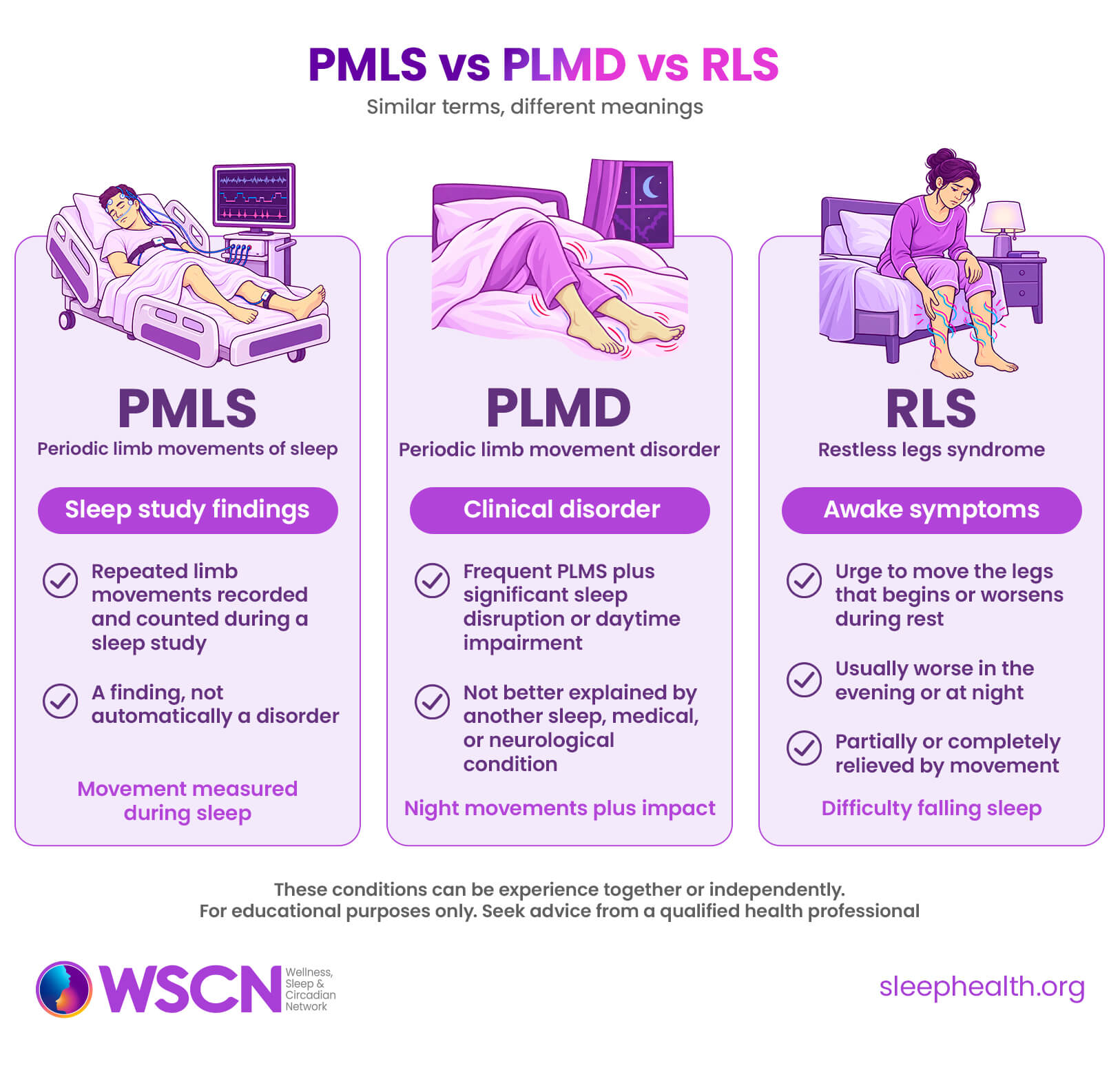
PLMD is different from having occasional leg twitches during sleep. Many adults have some periodic limb movements during a sleep study, especially with aging or other sleep or medical conditions. PLMD is diagnosed only when the movements are frequent, are linked with sleep disturbance or daytime impairment, and are not better explained by another sleep disorder, medical condition, mental health condition, medication, or substance.

Overview

  • PLMD involves repeated limb movements during sleep plus meaningful sleep disturbance or daytime impairment
  • The movements are usually involuntary and often involve the legs, such as ankle, toe, knee, or hip movements
  • A sleep study is needed to document periodic limb movements and evaluate whether another sleep disorder is present
  • PLMD is a diagnosis of exclusion, meaning other causes of the movements and symptoms must be considered first
  • PLMD is related to, but distinct from restless legs syndrome
  • Treatment focuses on identifying contributors, managing related conditions, improving sleep quality, and individualizing care with a qualified clinician

About periodic limb movement disorder

Periodic limb movements of sleep, often called PLMS, are repeated, stereotyped movements that occur during sleep. Stereotyped movements are movements that are repetitive, rhythmic, or patterned. They most often affect the legs and may look like brief flexing of the big toe, ankle, knee, or hip. The movements usually happen in a series and may recur at regular intervals.

PLMS are a common finding in sleep studies, especially in older adults and in people with other sleep or neurological conditions. Periodic Limb Movement Disorder, PLMD, is less common than PLMS. The disorder is diagnosed when frequent PLMS are associated with clinically significant sleep disturbance or daytime impairment and are not better explained by another condition.

PLMD and restless legs syndrome overlap but are not the same. Restless legs syndrome is diagnosed from symptoms while awake: an urge to move the legs, often with uncomfortable sensations, worse at rest and in the evening or night, and relieved by movement. PLMD is diagnosed from movements measured during sleep. Many people with restless legs syndrome have PLMS, but many people with PLMS do not have restless legs syndrome.
Signs and symptoms

PLMD can be difficult to recognize because the person is usually asleep when the movements occur. A bed partner may notice repeated kicking, jerking, twitching, or flexing movements. Some people learn about the movements only after a sleep study. 

PLMD happens during sleep, but its effects may be felt across the whole day. Repeated movements can be linked with fragmented sleep structure. The person may spend enough hours in bed but still wake feeling unrested.

Nighttime signs

A person or bed partner may notice:

  • Repeated leg or foot movements during sleep
  • Restless or disrupted sleep
  • Frequent brief awakenings
  • Bed covers that are kicked loose
  • Difficulty staying asleep
  • Sleep that feels light or unrefreshing

Daytime symptoms

Daytime effects may include:

  • Sleepiness or dozing unintentionally
  • Fatigue or low energy
  • Difficulty with concentration or memory
  • Irritability or low mood
  • Reduced work performance
  • Concern about driving or safety-sensitive tasks
  • Bed partner complaints

It is important to distinguish sleepiness from fatigue. Sleepiness means a tendency to doze or fall asleep. Fatigue means low energy or reduced capacity, even without a strong drive to sleep.

Screening and diagnosis

A primary care clinician can help start the evaluation. Depending on symptoms, referral may be made to a sleep medicine clinician, neurologist, psychiatrist, nephrologist, pharmacist, or another specialist.

PLMD diagnosis requires a sleep study, called polysomnography, because the movements must be measured during sleep. This helps show whether periodic limb movements are present and whether another sleep disorder, such as obstructive sleep apnea, may better explain the symptoms.

PLMD affects the entire 24-hours, and the best approach to diagnosis and treatment means looking beyond the leg movements alone. A helpful assessment considers sleep both daytime and nighttime symptoms. 

When to visit a doctor

If a person experiences the symptoms described above, or a bed partner’s sleep is suffering, it is recommended to make an appointment with a primary care physician or sleep specialist. They can conduct preliminary screenings and recommend next steps for diagnosis. 

It can be helpful to prepare information for an initial visit. Try using WSCN’s How to talk to your primary care clinician about sleep problems checklist.

It can also be helpful to make a note of:

  • Restless legs symptoms while awake
  • Medications and supplements
  • Caffeine, alcohol, nicotine, or other substances use
  • Kidney disease, diabetes, neuropathy, Parkinson’s disease, pregnancy history, pain, or other medical conditions
  • Bed partner observations and/or videos

When to seek urgent medical attention

It is usually fine to wait a few weeks for an appointment to talk about sleep issues.  However, the following symptoms may be dangerous, and should receive prompt medical attention:

  • New or worsening depression, hopelessness, or thoughts of self-harm
  • Falling asleep while driving or during safety-sensitive tasks

Questions to ask your doctor

Questions to ask may include:

  • Do my symptoms suggest PLMD, restless legs syndrome, sleep apnea, or another condition?
  • Do I need a sleep study?
  • Could my medications or supplements be contributing?
  • Should iron studies or other lab tests be checked?

Risk factors and contributors

PLMD and PLMS may be more likely or more severe in some adults. Risk factors and contributors can include:

  • Age: PLMS become more common with older age
  • Restless legs syndrome: Many people with restless legs syndrome also have periodic limb movements during sleep
  • Sleep disorders: Obstructive sleep apnea, narcolepsy, and REM sleep behavior disorder can be associated with PLMS
  • Medical and neurological conditions: Kidney disease, diabetes, neuropathy, Parkinson’s disease, and other neurological conditions may be relevant
  • Iron status: Low iron stores are important in restless legs syndrome and may be evaluated when leg movement symptoms are present
  • Medications and substances: Some antidepressants, antihistamines, dopamine-blocking medications, caffeine, alcohol, and nicotine may worsen sleep or movement symptoms in some people
  • Lifestyle and 24-hour rhythm factors: Physical inactivity, irregular sleep timing, insufficient sleep, and untreated sleep disruption can worsen daytime function, even when they are not the root cause

These factors are not personal failures. Identifying them helps the clinician decide what should be treated, changed, monitored, or ruled out.

Long-term health implications if PLMD is untreated or undertreated

Evidence is still developing, and PLMD-specific long-term outcome data are limited. However, persistent sleep fragmentation and daytime impairment deserve care because they may affect health, safety, and quality of life over time.

  • Heart and blood vessel health: PLMS can be associated with nighttime heart rate and blood pressure changes. Some studies link PLMS with cardiovascular risk markers, but causality is not fully established.
  • Metabolic health: Fragmented sleep may make it harder to maintain activity, meal timing, glucose regulation, and weight-related health routines, especially when other risk factors are present.
  • Mental health: Ongoing unrefreshing sleep can contribute to irritability, low mood, anxiety, and reduced resilience. Mental health symptoms can also worsen sleep.
  • Cognition and safety: Sleep fragmentation and sleepiness may affect attention, reaction time, memory, work performance, and drowsy driving risk.
  • Relationships and quality of life: Repeated movements can disturb a bed partner’s sleep and affect shared routines, intimacy, and household functioning.
  • Care delays: If PLMD-like symptoms are actually due to sleep apnea, restless legs syndrome, medication effects, kidney disease, neuropathy, or another condition, delayed evaluation can delay the right treatment.

Treatment and management

There is no one-size-fits-all treatment for PLMD. Management begins with confirming the diagnosis, identifying contributors, and clarifying whether another condition is driving the movements or the daytime symptoms. Treatment is then individualized.

A clinician may consider:

  • Treating obstructive sleep apnea or another sleep disorder if present
  • Assessing restless legs syndrome 
  • Reviewing medications
  • Checking iron levels
  • Addressing caffeine, alcohol, nicotine, and other substances that affect sleep
  • Managing pain, neuropathy, kidney disease, diabetes, or neurological conditions
  • Strengthening sleep timing, light exposure, activity, and other 24-hour supports
  • Medication in some limited instances

Bed partner considerations

Sleep is an essential component of good health across the 24-hour day, and sleep fragmentation from a partner’s movement can cause daytime symptoms such as sleepiness, brain fog, fatigue, and irritability. It is important to take a bed partner’s concerns seriously – particularly in conditions such as PLMD, which are often unnoticed by the person experiencing them.

People who share a bed with someone with PLMD may benefit from practical sleep supports, such as separate blankets, a mattress with good motion isolation, a larger sleep surface, or temporary sleep arrangements for nights when safety or severe sleep disruption is an issue. These steps may reduce conflict and protect sleep for both partners and ensure a vibrant, healthy life across all 24 hours.

Research and what we are still learning

PLMD remains an area where more research is needed. One major question is when periodic limb movements are the cause of sleep disturbance and when they are a marker of another sleep or health condition. Researchers are also studying how PLMS relate to cardiovascular physiology during sleep, which treatments improve patient-centered outcomes, and how to separate PLMD from overlapping conditions such as restless legs syndrome and obstructive sleep apnea.

Future studies need to focus not only on reducing movement counts, but also on outcomes that matter to people: sleep quality, daytime alertness, mood, safety, bed partner sleep, work performance, and quality of life.

References

American Academy of Sleep Medicine. (2023). International classification of sleep disorders (3rd ed., text rev.). American Academy of Sleep Medicine. https://pubmed.ncbi.nlm.nih.gov/25367475/

Ferrillo, F., Rundo, F., Zucconi, M., et al. (2021). Periodic limb movements during sleep: A narrative review. Journal of Thoracic Disease, 13(11), 6476–6494. https://pmc.ncbi.nlm.nih.gov/articles/PMC8662505/

Koo, B. B., Blackwell, T., Ancoli-Israel, S., et al. (2011). Association of incident cardiovascular disease with periodic limb movements during sleep in older men: Outcomes of Sleep Disorders in Older Men (MrOS) Study. Circulation, 124(11), 1223–1231. https://doi.org/10.1161/CIRCULATIONAHA.111.038968

Seifen C, Herrmann M, Pordzik J, Matthias C, Gouveris H. (2024) Periodic limb movements in patients with suspected obstructive sleep apnea without comorbid conditions. Front Med (Lausanne). 2024 Apr 26;11:1378410. doi: 10.3389/fmed.2024.1378410. PMID: 38737757; PMCID: PMC11082348. https://pubmed.ncbi.nlm.nih.gov/38737757/

Winkelman, J. W., Berkowski, J. A., DelRosso, L. M., et al. (2025). Treatment of restless legs syndrome and periodic limb movement disorder: An American Academy of Sleep Medicine clinical practice guideline. Journal of Clinical Sleep Medicine, 21(1), 137–152. https://doi.org/10.5664/jcsm.11390

Winkelman, J. W., Blackwell, T., Stone, K., et al. (2017). Associations of incident cardiovascular events with restless legs syndrome and periodic leg movements of sleep in older men. Sleep, 40(4), zsx023. https://doi.org/10.1093/sleep/zsx023


Medical disclaimer
This article is for educational purposes only and is not intended to replace professional medical advice, diagnosis, or treatment. Speak with a qualified healthcare professional about questions or concerns related to your sleep. Read full medical disclaimer