
Sleep & Circadian Health
Sleep stages and cycles
Stages of Sleep
Sleep stages are patterns of brain and body activity that occur during sleep. They can be measured during a sleep study using signals such as brain waves, eye movements, muscle activity, breathing, oxygen levels, heart rhythm, and body movement.
The two main categories are:
- Non-rapid eye movement sleep, often called non-REM sleep or NREM sleep
- Rapid eye movement sleep, often called REM sleep
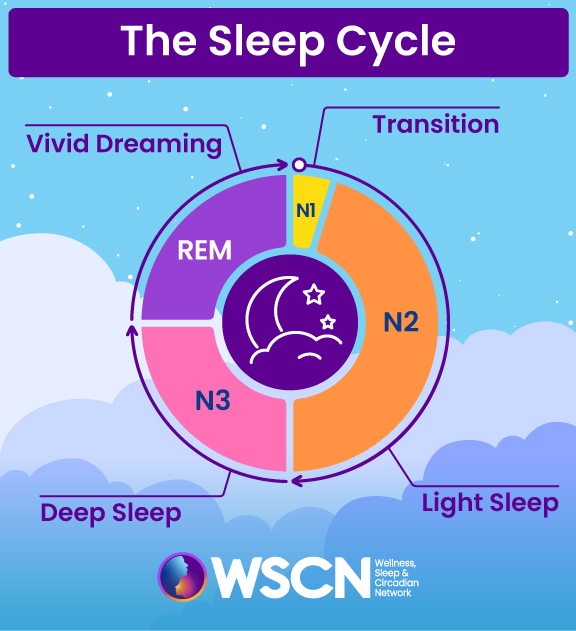
Both are essential and support specific brain and bodily functions that are required for restoration, repair, and regulation. A healthy sleep usually includes repeated cycling through non-REM and REM sleep, with most adults moving through 4-6 cycles per night.
Non-REM Sleep
NREM sleep has three stages, N1, N2 and N3, each with unique characteristics.
N1: light sleep
N1 is the transition between wakefulness and sleep. It is usually brief. During this stage, the body begins to relax, awareness decreases, and it is still relatively easy to wake. A person may drift in and out of awareness during this stage. Some people notice brief muscle twitches or a sensation of falling as they fall asleep.
N2: stable sleep
N2 is a deeper and more stable stage than N1. Heart rate and breathing tend to slow, body temperature drops, and the brain shows patterns called sleep spindles and K-complexes. N2 often makes up a large portion of total sleep time in adults. It helps protect sleep from minor disturbances and is involved in memory and learning processes. Some sleep monitoring apps call this “core” sleep.
N3: deep sleep
N3 is often called deep sleep or slow-wave sleep. During this stage, brain waves become slower, the body is more relaxed, and it is harder to wake someone.
Deep sleep is usually more prominent in the first half of the night. It is linked with physical restoration, immune function, growth and repair processes, energy regulation, and some forms of memory. Deep sleep tends to decrease with age, although healthy sleep remains important throughout life.
REM Sleep
REM sleep is a stage in which the brain becomes more active while most the muscles of the body relax and become inactive temporarily. The eyes make rapid movements behind closed eyelids. REM is a normal and important part of sleep that we cycle through several times during the night.
What happens in the brain and body
During REM sleep, the brain’s electrical activity often looks more “awake-like” than in deep non-REM sleep, with faster, lower-amplitude rhythms.
At the same time:
- Most skeletal muscles are inhibited by REM atonia, a type of temporary paralysis, which reduces the ability to act out dreams
- Breathing and heart rate can become more irregular
- Temperature regulation changes occur
Dreaming and emotion
Vivid dreaming is common in REM sleep (though dreaming can occur in other stages too). REM is often discussed as a stage that supports processing of emotional experiences, which is important for supporting mental health and wellbeing.
Learning and memory
Research in humans and animals suggests REM sleep contributes to some forms of learning and memory, and the integration of new information with existing knowledge. More broadly, evidence demonstrates that both non-REM and REM sleep stages play roles in memory consolidation. Rather than one stage doing “all” the work, different stages may contribute to different parts of memory and learning.
How REM changes across the night
The first REM period of the night is usually shorter. REM periods often become longer in the second half of the night, as deep non-REM sleep becomes less prominent. This is one reason why sleep in early hours of the morning can be especially rich in REM.
What is important to understand is that REM and NREM sleep are not more or less important than each other. What is essential is that sleep duration is long enough so that the brain and body can move through the required number of sleep cycles an individual needs to be healthy and balanced.
- American Academy of Sleep Medicine. (2023). International classification of sleep disorders (3rd ed., text rev.). https://aasm.org/clinical-resources/international-classification-sleep-disorders/
- Medic, G., Wille, M., & Hemels, M. E. H. (2017). Short- and long-term health consequences of sleep disruption. Nature and Science of Sleep, 9, 151–161. https://doi.org/10.2147/NSS.S134864
- Patel, A. K., Reddy, V., & Araujo, J. F. (2026). Sleep study. In StatPearls. StatPearls Publishing. https://www.ncbi.nlm.nih.gov/books/NBK563147/
- Rasch, B., & Born, J. (2013). About sleep’s role in memory. Physiological Reviews, 93(2), 681–766. https://doi.org/10.1152/physrev.00032.2012
- Roth, T. (2009). Slow wave sleep: Does it matter? Journal of Clinical Sleep Medicine, 5(2 Suppl), S4–S5. https://pmc.ncbi.nlm.nih.gov/articles/PMC2824210/
- Walker, M. P., & Stickgold, R. (2004). Sleep-dependent learning and memory consolidation. Neuron, 44(1), 121–133. https://doi.org/10.1016/j.neuron.2004.08.031
- Chinoy, E. D., Cuellar, J. A., Huwa, K. E., et al. (2021). Performance of seven consumer sleep-tracking devices compared with polysomnography. Sleep, 44(5), zsaa291. https://doi.org/10.1093/sleep/zsaa291