
Across The Body
Sleep and circadian, the heart and vascular health
Sleep and cardiovascular health are closely connected. During healthy sleep, heart rate and blood pressure change as the body moves through different stages of sleep. These changes give the heart and blood vessels a period of overnight rest and recovery. Sleep also interacts with the nervous system, metabolism, inflammation, and the body’s internal circadian rhythm.
The relationship works both ways. Poor or disrupted sleep is associated with cardiovascular risk factors and cardiovascular disease. Heart and blood vessel conditions can also interfere with sleep through symptoms, medications, or changes in daily routines.
Looking at sleep across the full 24-hour cycle can help people understand how sleep duration, sleep quality, sleep timing, and sleep regularity may relate to cardiovascular health.
This page can help patients and caregivers recognize connections between sleep and cardiovascular health and prepare for a more focused conversation with a clinician.
Overview
- Sleep is essential to cardiovascular health
- Heart rate, blood pressure, and other cardiovascular functions change naturally during sleep
- Poor sleep is linked with hypertension (high blood pressure), coronary artery disease, heart failure, and arrhythmias
- Healthy sleep involves more than getting enough sleep: sleep quality and regularity also play a role
- Cardiovascular conditions can disturb sleep through symptoms such as breathlessness, discomfort, or nighttime waking
- Sleep apnea has particularly strong links with cardiovascular disease
- Looking at sleep across the full 24 hours can help reveal patterns between sleep, symptoms, and cardiovascular health
ON THIS PAGE
-
How sleep and the cardiovascular system are connected
-
How cardiovascular conditions can affect sleep and circadian rhythm
-
How poor sleep can affect cardiovascular health
-
24-hour view: circadian rhythm and whole-day cardiovascular health
-
Sleep concerns by cardiovascular condition
-
Cardiovascular sleep concerns that may need medical attention
-
What to track before an appointment
How sleep and the cardiovascular system are connected
Sleep is an important restorative period for cardiovascular health. The heart continues to pump blood throughout the night, but during healthy sleep the cardiovascular system generally shifts into a lower-demand state. Heart rate and blood pressure usually decrease, giving the heart and blood vessels a period of relative rest.
These changes are partly controlled by the autonomic nervous system, which automatically adjusts functions such as heart rate and blood pressure without us having to think about it. During sleep, it helps slow the heart rate and allows blood vessels to relax or tighten as needed, helping blood pressure follow its normal nighttime pattern.
These processes are also connected to the circadian system. Circadian rhythms help coordinate cardiovascular and metabolic activity across the 24-hour day.
Sleep and cardiovascular function
- Blood pressure: Blood pressure normally decreases during sleep and rises again around waking.
- Heart rate: Heart rate and the body’s automatic control of heart function change across different stages of sleep.
- Blood vessels: Sleep helps blood vessels relax and supports the healthy function of their inner lining, called the endothelium.
- Metabolism: Sleep interacts with blood sugar regulation and other cardiometabolic processes.
- Inflammation: Poor or disrupted sleep may increase inflammation in the body, which can place added stress on the heart and blood vessels.
- Circadian rhythm: Internal biological clocks help coordinate cardiovascular activity across day and night.
How cardiovascular conditions can affect sleep and circadian rhythm
Cardiovascular disease can disrupt sleep in various ways. The relationship works in both directions. A cardiovascular condition may disrupt sleep, while poor sleep may also have an impact on cardiovascular health.
Common reasons sleep may be disrupted include:
- Breathing difficulties: Some cardiovascular conditions can cause breathlessness that becomes more noticeable when lying down or during the night.
- Nighttime symptoms: Palpitations, discomfort, coughing, or other symptoms can interrupt sleep.
- Sleep apnea: Sleep-disordered breathing frequently occurs alongside cardiovascular conditions and may itself fragment sleep.
- Medication effects: Some cardiovascular medications may affect sleep by causing vivid dreams, increasing nighttime urination, or contributing to changes in alertness or fatigue.
- Hospital care and recovery: Hospitalization, procedures, rehabilitation, and changes in usual routines can disrupt sleep timing and quality.
- Worry about symptoms: Concerns about cardiovascular symptoms or recovery can make it harder to fall asleep or return to sleep.
Note: Sleep problems in people with cardiovascular conditions may have more than one cause. The cardiovascular condition itself, medications, sleep apnea, stress, pain or discomfort, and changes in daily routines can all contribute. A careful assessment can help identify what is affecting sleep and guide the most appropriate next steps.
How poor sleep can affect cardiovascular health
A few nights of poor sleep do not mean that a person will develop cardiovascular disease. However, research clearly links unhealthy sleep with poorer cardiovascular health, particularly over extended time frames. The evidence is compelling enough that the American Heart Association recommends sleep as part of it’s “Life’s Essential 8s” for cardiovascular health.
The relationship is broader than simply getting too little sleep. Research increasingly examines several dimensions of sleep together, including duration, quality, regularity, daytime sleepiness, and sleep disorders.
Poor or disrupted sleep may affect cardiovascular health by altering blood pressure and nervous-system activity. It may also influence metabolism and inflammation.
Short sleep has been associated with higher cardiovascular risk. Some studies also report higher risk among people with very long sleep durations.
Sleep timing and regularity may also matter, suggesting that cardiovascular health is influenced not only by sleep duration, but also by when a person sleeps and how consistent their sleep schedule remains.
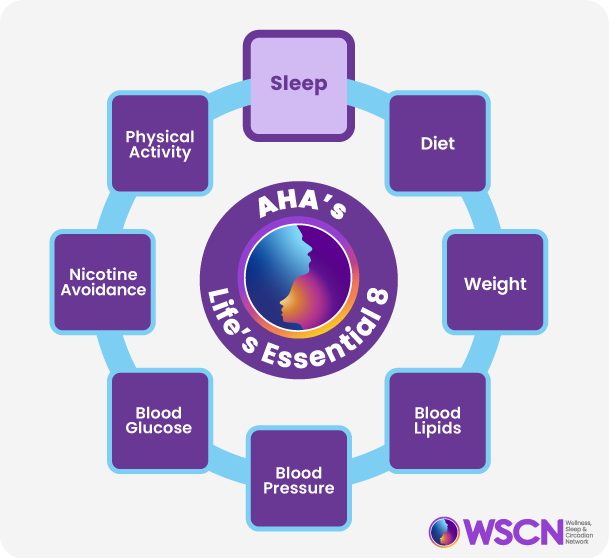
Image adapted from the AHA Life’s Essential 8.
24-hour view: circadian rhythm and whole-day cardiovascular health
Sleep is one part of a 24-hour biological cycle. The circadian system helps coordinate sleep and wakefulness with daily rhythms in blood pressure, heart rate, metabolism, hormone release, and other cardiovascular processes.
This means cardiovascular health is influenced not only by how much a person sleeps, but also by when sleep occurs and how consistent sleep patterns are from one day to the next.
Sleep irregularity can include large changes in bedtime, wake time, or sleep duration from day to day. Shift work, travel, artificial light at night, and other lifestyle patterns can disrupt usual sleep timing.
OWN ALL 24 HOURS
How you sleep at night can affect the cardiovascular system during the day. What happens during the day can also shape sleep that night.
Understanding the links between sleep and cardiovascular health can help you recognize why getting a good night’s sleep should be a priority.
When living with a heart or blood vessel condition, reviewing the full 24 hours can help identify patterns in sleep timing, activity, symptoms, medication use, and daily routines. This can be used to optimize your health and well-being.
Sleep concerns by cardiovascular condition
Cardiovascular risk factors and sleep
Sleep is also connected with several factors that influence long-term cardiovascular risk, including blood pressure, glucose regulation, body weight, and metabolic health. Poor or irregular sleep may affect these factors over time, while the same conditions can also make healthy sleep more difficult.
Blood pressure
Short or disrupted sleep may interfere with normal nighttime blood-pressure regulation.
Glucose regulation
Too little sleep and disrupted sleep timing can affect how the body regulates blood sugar, leading to high glucose levels, insulin resistance and blood vessel inflammation and damage over time if not managed.
Body weight
Short sleep has been associated with obesity and weight gain. Obesity can also increase the likelihood of obstructive sleep apnea, creating a two-way relationship between sleep and metabolic health.
Metabolic syndrome
Poor sleep duration, irregular sleep, and poor sleep quality have all been associated with metabolic syndrome in population studies.
Blood lipids
Poor sleep has been associated with changes in cholesterol and triglyceride levels, which can contribute to cardiovascular disease risk.
Arterial health
Poor or irregular sleep has been linked with changes in blood-vessel function and early signs of atherosclerosis.
Note: These relationships are complex. Sleep is one part of cardiovascular risk, alongside physical activity, diet, smoking, blood pressure, glucose levels, and blood cholesterol.
Related sleep disorder: Sleep apnea
Sleep apnea is closely linked with cardiovascular health. Repeated pauses in breathing can lower blood oxygen, disrupt sleep, and place extra stress on the cardiovascular system. Sleep apnea is associated with hypertension, atrial fibrillation, coronary artery disease, and heart failure. People with cardiovascular disease may not always recognize sleep apnea, even when it is disrupting their sleep or affecting their cardiovascular health.
Cardiovascular sleep concerns that may need medical attention
Sleep changes are common, but some symptoms are worth discussing with a healthcare professional, particularly when they are new or persistent. Patients or caregivers should seek medical advice for:
- Persistent difficulty sleeping or repeated nighttime awakenings
- Loud snoring, breathing pauses, choking, or gasping during sleep
- Excessive daytime sleepiness
- Palpitations or a racing or irregular heartbeat around sleep
- Breathlessness that interrupts sleep or becomes worse when lying down
- Persistent fatigue despite getting enough sleep
- Significant changes in usual sleep duration or sleep timing
- Sleep problems that begin after a cardiovascular diagnosis or medication change
A clinician can help determine whether sleep symptoms may relate to a cardiovascular condition, a medication, or an underlying sleep disorder. Depending on the symptoms, further assessment may include cardiovascular evaluation or a sleep study. Sudden chest pain, severe shortness of breath, fainting, or symptoms of a possible heart attack or stroke require urgent medical attention.
What to track before an appointment
Tracking sleep and cardiovascular symptoms across the full day and night can make concerns easier to discuss with a clinician. It may also help identify patterns that could guide further assessment.
Useful things to track include:
- Regular bedtime and wake time, and any changes to routine
- Night wakings and reasons for them
- Daytime sleepiness or naps
- Snoring, gasping, or witnessed breathing pauses
- Palpitations or changes in heartbeat
- Any increase or change in cardiovascular symptoms
- Breathlessness during the night or when lying down
- Blood pressure readings, when already being monitored
- Medication timing and recent medication changes
- Caregiver or bed-partner observations
A short record over several days may reveal connections between sleep timing, nighttime symptoms, daytime function, and cardiovascular health that are difficult to remember during an appointment.
Jaspan, V. N., Greenberg, G. S., Parihar, S., et al. (2024). The role of sleep in cardiovascular disease. Current Atherosclerosis Reports, 26, 249–262. https://doi.org/10.1007/s11883-024-01207-5
Amin, K. D., Thakkar, A., Budampati, T., et al. (2025). A good night’s rest: A contemporary review of sleep and cardiovascular health. American Journal of Preventive Cardiology, 21, 100924. https://doi.org/10.1016/j.ajpc.2024.100924
Huang, B.-H., del Pozo Cruz, B., Teixeira-Pinto, A., Cistulli, P. A., & Stamatakis, E. (2023). Influence of poor sleep on cardiovascular disease-free life expectancy: A multi-resource-based population cohort study. BMC Medicine, 21, 75. https://doi.org/10.1186/s12916-023-02732-x
Wu, Y., Li, Z., Zhao, P., Xu, J., & Yuan, M. (2025). Sleep patterns and cardiovascular disease risk in US participants: A comprehensive analysis. Frontiers in Neuroscience, 18, 1447543. https://doi.org/10.3389/fnins.2024.1447543
Huang, T. (2025). Sleep irregularity, circadian disruption, and cardiometabolic disease risk. Circulation Research, 137, 709–726. https://doi.org/10.1161/CIRCRESAHA.125.325613
Miller, M. A., & Howarth, N. E. (2023). Sleep and cardiovascular disease. Emerging Topics in Life Sciences, 7, 457–466. https://doi.org/10.1042/ETLS20230111
American Heart Association. Life’s Essential 8 – checklist for lifelong good health. https://www.heart.org/en/healthy-living/healthy-lifestyle/lifes-essential-8
This article is for educational purposes only and is not intended to replace professional medical advice, diagnosis, or treatment. Speak with a qualified healthcare professional about questions or concerns related to your sleep. Read full medical disclaimer
