
Across The Body
Alzheimer’s Disease
Alzheimer’s disease is the leading cause of dementia, impacting memory, cognition, behavior, and daily activities. Sleep changes in people with Alzheimer’s Disease are also common and can have a major impact on the person living with the condition and their caregivers.
This page explains how Alzheimer’s disease can disrupt sleep and circadian rhythm and how families can support safer, more predictable days and nights.
Overview
- Alzheimer’s disease can make sleep lighter, more fragmented, and less aligned with day and night
- Common concerns include nighttime waking, daytime napping, evening confusion, wandering, and sleep disruption for caregivers
- Consistent daytime cues and nighttime safety planning may help make routines more predictable
- Sleep apnea and other sleep disorders can occur alongside Alzheimer’s disease and may need separate assessment
- Changes in sleep can be informative for the progression of disease in neurological disorders and may introduce an opportunity for treatment changes and lifestyle optimization
Why sleep, circadian and Alzheimer’s disease are biologically connected
Alzheimer’s disease is a progressive neurological condition and the leading cause of dementia. It damages brain cells and networks involved in memory and thinking. Over time, it can also affect behavior, daily functioning, and the brain systems that regulate sleep and circadian timing.
Sleep is an active biological process that supports memory formation and the coordination of brain networks. Both deep sleep and REM sleep contribute to how the brain processes and stores information.
During deep non-REM sleep, recently learned information is reinforced and integrated with existing memories. REM sleep appears to support emotional processing and some forms of learning. These sleep-dependent functions are especially relevant in Alzheimer’s disease because the condition affects many of the same brain networks involved in memory and thinking.
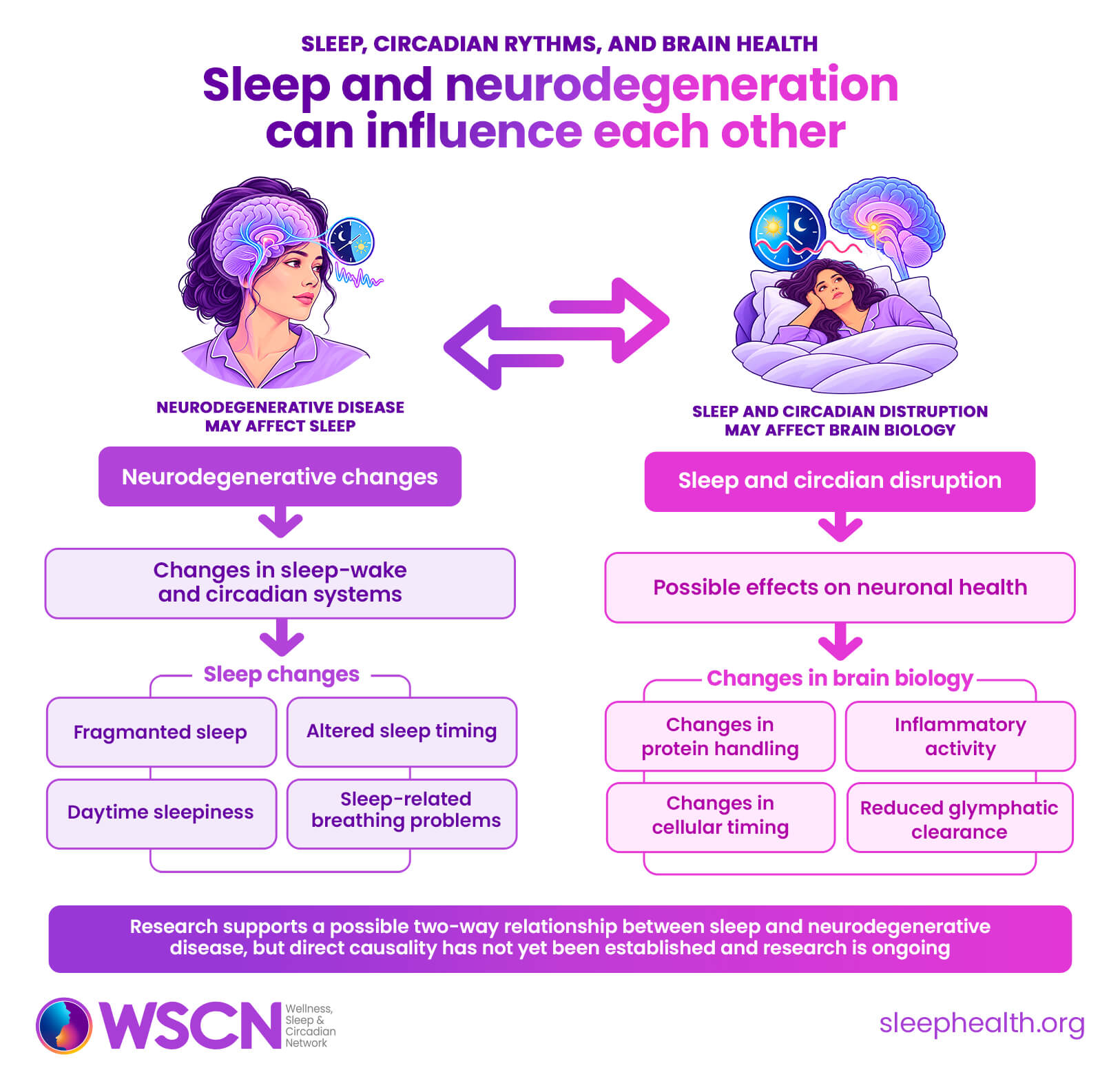
Deep sleep also supports the brain’s glymphatic system. This clearance network uses the movement of fluid around brain cells to remove metabolic waste, including soluble amyloid beta and tau proteins. Fragmented sleep may make the glymphatic clearance process less efficient. Longer periods of wakefulness may also increase the release of these proteins. Over time, an imbalance between production and clearance of these proteins may contribute to abnormal accumulation in the brain.
Alzheimer-related changes can then affect the systems that control sleep. Tau pathology can involve wake-promoting neurons in the locus coeruleus, a brainstem region that helps maintain alertness and supports transitions between sleep and wakefulness. Changes can also occur in the suprachiasmatic nucleus, which serves as the brain’s main circadian clock. Damage in these regions may weaken the signals that keep daytime activity and nighttime sleep aligned.
This may create a self-reinforcing cycle. Sleep disruption can interfere with protein clearance, while damage to sleep-wake and circadian systems can further fragment sleep. The exact direction and strength of these relationships are still being studied. Poor sleep does not mean a person has Alzheimer’s disease, and improving sleep has not been shown to prevent or reverse the condition.
How Alzheimer’s disease affects daytime and nighttime routines
Alzheimer’s disease can affect the brain systems that regulate sleep, wakefulness, and circadian timing. The changes vary from person to person and may affect behavior, safety, and caregiver sleep.
Frequent nighttime waking
Sleep may become lighter and more broken. A person may wake repeatedly or remain awake for long periods during the night.
Daytime sleepiness or long naps
Poor nighttime sleep and changes in the body clock can shift more sleep into the daytime. Long or late naps may then make nighttime sleep more difficult.
Evening confusion or restlessness
Some people become more confused, anxious, or unsettled later in the day. This pattern is often called sundowning, although it does not occur in everyone and may have more than one cause.
Disorientation and nighttime safety
Memory and orientation changes can make nighttime waking confusing. A person may not recognize where they are, understand the time of day, or remember why they got out of bed. This can increase the risk of falls, wandering, or leaving the home.
Caregiver sleep disruption
Repeated waking and the need to monitor nighttime safety can affect caregivers’ sleep, health, and ability to continue providing care.
24-hour view: circadian rhythm and care in Alzheimer’s disease
Sleep, behavior, activity, and caregiving are connected across the full 24-hour day. Looking at the overall pattern, rather than nighttime sleep alone, can help families and care teams plan more consistent routines and recognize meaningful changes.
How to support circadian rhythm, sleep and nighttime safety for people with Alzheimer’s disease
The best approach depends on what is disturbing sleep. Strategies should be adapted to the person’s abilities, preferences, usual routines, and stage of Alzheimer’s disease.
Supporting a clearer day-night pattern
A reasonably consistent wake time, exposure to daylight, regular meals, and suitable daytime activity can help reinforce the difference between day and night. Keeping the daytime active and predictable may also reduce long periods of inactivity and support sleepiness at bedtime.
Planning daytime rest
Daytime rest may be helpful, especially after a poor night. However, long naps or naps taken after 3 p.m. can make it harder to sleep at night. Notice whether the timing or length of naps is followed by more nighttime waking or evening restlessness.
Making the nighttime environment safer
Keep walking routes clear, reduce fall hazards, and make the bathroom easy to find. Familiar surroundings and soft lighting can reduce confusion after waking. A calm, reassuring approach may also help if the person is frightened or disoriented.
Checking for discomfort
Pain, constipation, urinary symptoms, breathing problems, hunger, thirst, or feeling too hot or cold can all disturb sleep. Because a person with Alzheimer’s disease may have difficulty explaining what is wrong, changes in movement, facial expression, behavior, or appetite may provide important clues.
Reviewing medications
Medication timing and side effects should be reviewed with the care team, particularly when sleep or behavior changes after a medicine is started or adjusted. Some medicines may contribute to confusion, balance problems, vivid dreams, nighttime alertness, or daytime drowsiness.
Including caregiver needs
Nighttime care plans should also consider caregiver sleep, health, and ability to provide safe care. Repeated waking and supervision can become difficult to manage over time. Families may need support from clinicians, home-care services, respite programs, or community dementia organizations.
Other causes of sleep problems in Alzheimer’s disease
It is important to recognize that some sleep problems may not be directly caused by Alzheimer’s disease. Physical discomfort, illness, emotional distress, medication changes, and separate sleep disorders such as sleep apnea can also disrupt sleep. Changes in the home or care setting can also play a role. This is especially important when the person has difficulty communicating pain, urinary symptoms, constipation, or other sources of discomfort.
When sleep changes in people with Alzheimer’s disease need clinical review
Sleep and circadian patterns can provide useful clues about neurological health. Changes in sleep may sometimes reflect changes in an underlying neurological condition before daytime symptoms become more obvious. This is especially relevant in Alzheimer’s disease, where sleep and circadian disruption are common and may occur alongside changes in cognition and daily function.
In some neuromuscular disorders, changes in sleep or nighttime breathing may provide an early sign that the condition is changing and could prompt treatment review before daytime symptoms worsen.
Contact the care team when sleep or behavior changes suddenly or becomes harder to manage. This includes new wandering or falls, sleeping much of the day and staying awake much of the night, sudden increase in daytime napping or sleepiness, or situations in which nighttime care is no longer safe.
A sudden increase in confusion may be caused by infection, pain, dehydration, constipation, medication side effects, or another medical condition rather than Alzheimer’s progression. Sudden confusion with fever or another major change in health requires prompt medical evaluation. Loud snoring, gasping, or pauses in breathing should also be discussed, as these may indicate sleep apnea, which can be assessed and treated separately.
For a fuller list of neurological sleep warning signs, see Sleep & circadian, the brain, and neurological conditions.
Casagrande, M., Forte, G., Favieri, F., & Corbo, I. (2022). Sleep quality and aging: A systematic review on healthy older people, mild cognitive impairment and Alzheimer’s disease. International Journal of Environmental Research and Public Health, 19(14), Article 8457. https://doi.org/10.3390/ijerph19148457
Chen, C.-L., Zhang, M.-Y., Wang, Z.-L., Deng, J.-H., Bao, Y.-P., Shi, J., Lu, L., & Shi, L. (2025). Associations among sleep quality, sleep duration, and Alzheimer’s disease biomarkers: A systematic review and meta-analysis. Alzheimer’s & Dementia, 21(3), Article e70096. https://doi.org/10.1002/alz.70096
Chen, J., Peng, G., & Sun, B. (2024). Alzheimer’s disease and sleep disorders: A bidirectional relationship. Neuroscience, 557, 12–23. https://doi.org/10.1016/j.neuroscience.2024.08.008
Süzgün, M. A., Tang, Q., & Stefani, A. (2025). Sleep abnormalities and risk of Alzheimer’s disease. Current Neurology and Neuroscience Reports, 25, Article 67. https://doi.org/10.1007/s11910-025-01451-5
Zhang, Y., Ren, R., Yang, L., Zhang, H., Shi, Y., Okhravi, H. R., Vitiello, M. V., Sanford, L. D., & Tang, X. (2022). Sleep in Alzheimer’s disease: A systematic review and meta-analysis of polysomnographic findings. Translational Psychiatry, 12, Article 136. https://doi.org/10.1038/s41398-022-01897-y
This article is for educational purposes only and is not intended to replace professional medical advice, diagnosis, or treatment. Speak with a qualified healthcare professional about questions or concerns related to your sleep. Read full medical disclaimer
