
Sleep & Circadian Health

Sleep in infants

Sleep changes throughout life. In infancy, sleep is shaped by rapid brain and body development, feeding needs, caregiving patterns, and the gradual development of the body’s internal clock. Sleep plays an important role in early brain development, growth, emotional regulation, and the emerging sleep–wake rhythms that help organize a baby’s day and night. Understanding what’s typical — and what may need support — can help parents, caregivers, and clinicians protect sleep and circadian health from the very beginning of life.

If unpredictable naps, frequent night wakings, or a wide-awake baby at 3 a.m. sound familiar, you’re not alone. In fact, fragmented sleep is common in early infancy, with sleep patterns becoming more predictable as babies grow. This page explains typical sleep behaviors, why infant sleep matters, and when extra support may help.

Overview

Typical Sleep Need

As a general guide, across a 24 hour period:

  • Newborns 0–3 months = 14–17 hours of sleep
  • Infants 4–12 months = 12–16 hours of sleep including naps
  • Sleep is spread across day and night, especially in the first months

Common Sleep Pattern

  • Fragmentation: babies sleep in multiple short periods across day and night
  • Frequent waking is common for feeding, comfort and care. 
  • Over the first year, sleep gradually occurs for longer stretches at night
  • More predictable nap and wake patterns emerge

Key Circadian Features

Babies are not born with a developed 24-hour circadian rhythm. Their internal body clock develops gradually, with early day–night patterns often emerging around 6–12 weeks and becoming more established over the first year. Light exposure, feeding patterns, caregiving routines, and daytime activity help shape this rhythm.

Common Challenges

  • Frequent night waking and short sleep stretches
  • Irregular naps and initially lacking day-night rhythm 
  • Difficulty settling
  • Sleep regressions
  • Caregiver sleep disruption
  • Many of these patterns are developmentally normal, especially in early infancy

When to Seek Help

Seek help if sleep concerns:

  • Persist or get worse over time
  • Affect feeding, growth, breathing, or safety
  • Include breathing pauses, gasping, poor weight gain, unusual lethargy, or extreme sleepiness
  • Are seriously affecting caregiver wellbeing or mental health

Why sleep matters during infancy

Sleep is one of the foundations of healthy infant development. In the first year of life, babies are growing rapidly, building new brain connections, developing early sleep–wake rhythms, and learning to regulate feeding, alertness, and emotional responses. Sleep is an essential and active part of how the infant brain and body mature.

Healthy sleep during infancy supports learning, memory, physical growth, emotional regulation, and the gradual development of the body’s natural circadian rhythm. It also matters for parents and caregivers, whose own sleep and wellbeing are closely tied to the baby’s sleep.

When infant sleep is very short, poorly timed, or highly fragmented, it can have ripple effects. Babies may have more difficulty settling, feeding, staying alert when awake, or regulating emotions. Some irregular sleep and night waking are normal in infancy, but understanding what’s typical can help families feel more confident — and know when extra support may help.

Mother With Sleeping Newborn

What Sleep Looks like in Infancy

Infant sleep changes quickly across the first year. Early sleep is often irregular and spread across day and night, but gradually becomes more organized as the brain, body, and circadian system mature.

  • Sleep needs are high: Newborns need ~14–17 hours of sleep across 24 hours. Older infants 4-12 months need about 12–16 hours, including naps.
  • Sleep is often fragmented: Infants usually sleep in short stretches and wake often for feeding, comfort, and care.
  • Day-night rhythms develop gradually: By around 4–6 months, many infants begin developing more recognizable sleep cycles, with longer stretches of nighttime sleep.
  • Naps become more predictable: Across the first year, daytime sleep usually shifts from many short naps toward a clearer nap pattern.
  • Night waking is  normal: Even as sleep becomes more consolidated, waking during the night is common for feeding, comfort and care. 
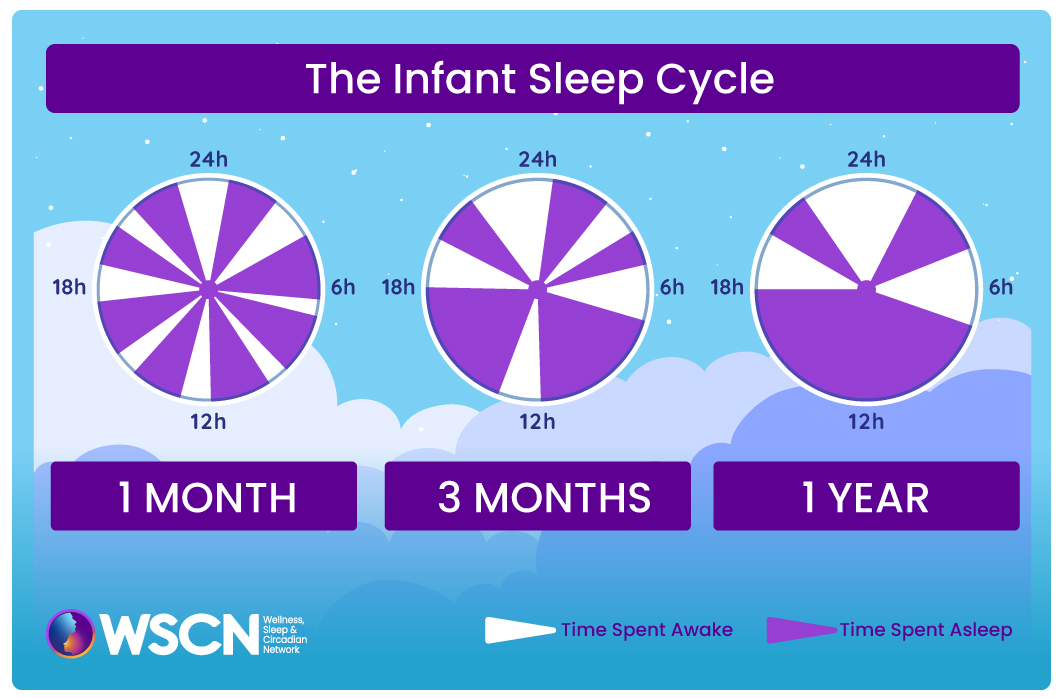
The Infant Sleep Cycle

The circadian rhythm in infants

Circadian rhythms are the body’s internal 24-hour timing system. They help organize sleep, wakefulness, feeding, digestion, hormones, body temperature, and alertness.

During infancy, this system is still developing, so sleep can be irregularly spread across day and night. Around 4-6 months of age babies gradually become more responsive to day–night cues, and variation is normal. From 6-12 months a clearer day-night rhythm emerges, with longer stretches of nighttime sleep supported by daytime naps.

What healthy sleep means in infants

Healthy infant sleep is not about sleeping perfectly or “through the night” as early as possible. It means sleep is safe, developmentally appropriate, and supportive of the baby’s growth, rhythms, and wellbeing.

Timing

Sleep gradually begins to align with the baby’s developing day–night rhythm

Duration

A baby gets enough total sleep across 24 hours for their age and individual needs

Regularity

Sleep and wake patterns become more predictable over time, while still allowing for normal variation

Efficiency

A baby can settle into sleep and return to sleep with age-appropriate support

Alertness

During wake periods, the baby is able to feed, engage, and respond in ways that are typical for their age

Satisfaction

Caregivers observe that their baby seems settled, rested, and generally well between sleep periods

Common sleep challenges in infants

Infant sleep varies widely, especially in the first year. Frequent waking, short naps, and changing sleep patterns are often part of normal development — not necessarily signs that something is wrong.

Common sleep challenges can include:

  • Frequent night waking
  • Irregular naps
  • Short sleep stretches
  • Difficulty settling
  • Sleep regressions
  • Day–night confusion
  • Caregiver sleep disruption

Circadian misalignment can make these challenges harder. Low daytime light, bright light at night, inconsistent routines, irregular feeding patterns, illness, travel, or frequent disruption can blur the difference between day and night and make sleep feel less settled.

What can support healthy sleep in infants

While a baby is still developing their circadian rhythm, parents and caregivers can create a supportive environment. This can include working with timing of activities and sleep, light exposure and establishing household routines.

Some evidence-based suggestions include:

  • Use light as the main cue: Bright natural light during the day and dimmer light in the evening can help babies learn the difference between day and night
  • Keep daytime active and social: Daytime feeding, interaction, movement, and normal household sounds can help signal “day”
  • Make nights quieter and calmer: Lower light, quieter feeds, and minimal stimulation can help signal “night”
  • Build gentle routines: Predictable patterns around feeding, caregiving, naps, and bedtime can support the body clock as it matures
  • Expect flexibility: Illness, travel, growth, feeding changes, and disrupted routines can temporarily unsettle sleep
  • Avoid pressure for perfection: Families do not need a strict schedule in the early months. Small, consistent cues are often enough to support healthy circadian development.

When to seek help

Infant sleep can vary a lot, and many changes are part of normal development. The strongest predictor for healthy infant and child sleep is parents/caregivers that are informed and well-supported, so it’s worth checking in with a pediatrician or qualified healthcare professional if sleep concerns are persistent, worsening, or causing worry. If something feels wrong, trust your instinct. Families do not need to wait until a sleep concern becomes severe before asking for help from a trusted healthcare provider. 

Seek support if your baby:

  • Has breathing pauses, gasping, snoring, or labored breathing during sleep
  • Is unusually sleepy, difficult to wake, or hard to keep awake for feeds
  • Has persistent feeding difficulties, fewer wet diapers, or poor weight gain
  • Seems unusually bothered, distressed, or difficult to soothe
  • Has sleep disruption linked to illness, reflux, pain, medication, or another health concern
  • Has sleep patterns that are seriously affecting parent/caregiver wellbeing or mental health
References
  1. Buysse, D. J. (2014). Sleep health: Can we define it? Does it matter? Sleep, 37(1), 9–17. https://doi.org/10.5665/sleep.3298
  2. Kok, E. Y., Kaur, S., Mohd Shukri, N. H., Abdul Razak, N., Takahashi, M., Teoh, S. C., Tay, J. E. F., & Shibata, S. (2025). The role of light exposure in infant circadian rhythm establishment: A scoping review perspective. European Journal of Pediatrics, 184, Article 112. https://doi.org/10.1007/s00431-024-05951-3
  3. Mindell, J. A., & Moore, M. (2018). Does sleep matter? Impact on development and functioning in infants. Pediatrics, 142(6), Article e20182589. https://doi.org/10.1542/peds.2018-2589
  4. Morse, A. M. (2019). Sleep and neurodevelopment. Practical Neurology, March/April, 32–36. https://practicalneurology.com/diseases-diagnoses/sleep/sleep–neurodevelopment/30107/ 
  5. National Heart, Lung, and Blood Institute. (2022, March 24). How sleep works: How much sleep is enough? National Institutes of Health. Retrieved May 30, 2025, from https://www.nhlbi.nih.gov/health/sleep/how-much-sleep
  6. Pudasainee-Kapri, S., Zhang, Y., & Razza, R. A. (2025). Early bedtime routines and behavioral outcomes among children from low-income families: Mediating role of emotion regulation. Infant Behavior and Development, 78, Article 102027. https://doi.org/10.1016/j.infbeh.2025.102027

Medical disclaimer
This article is for educational purposes only and is not intended to replace professional medical advice, diagnosis, or treatment. Speak with a qualified healthcare professional about questions or concerns related to your sleep. Read full medical disclaimer