
Sleep Problems & Disorders
Sleepwalking and night terrors in adults
Sleepwalking and sleep terrors are non-rapid eye movement (NREM) parasomnias, which means they are unwanted events that arise when the brain only partly awakens from deeper stages of sleep. A person may walk, speak, appear frightened, or perform complex actions while awareness and judgment remain limited. They may remember little-to-nothing of the event the next morning.
These events are real sleep conditions. Typically more common in childhood, sleep walking and night terrors can persist or even begin in adulthood. Evaluation can clarify the diagnosis, identify triggers or related conditions, and reduce safety risks for the person and household.
This page focuses on adults. Information is also available for Sleepwalking and Sleep Terrors in Children and Teens.
Overview
- Sleepwalking and sleep terrors are disorders of arousal (partial awakening) that usually begin during deep NREM sleep
- A person may look awake but be confused, difficult to redirect, and unable to make safe decisions
- A person may also engage in actions that are safe but unwanted, such as eating, moving objects, or performing tasks
- Sleepwalking involves getting out of bed or performing actions; sleep terrors involve sudden intense fear and strong body activation, and the two can overlap
- Sleep loss, irregular schedules, stress, alcohol, some medications, and other sleep disorders may increase the chance of an episode
- Safety planning is central when episodes involve wandering, falls, leaving the home, or other dangerous behavior
- Treatment focuses on identifying contributors, protecting safety, supporting stable sleep, and using individualized behavioral or medical care when needed
About sleepwalking and night terrors
During an episode, movement and the body’s alarm systems can become active while parts of the brain responsible for awareness, memory, and judgment remain asleep. Episodes often occur in the first portion of the night, when deep NREM sleep is more common.
Sleepwalking, also called somnambulism, may involve sitting up, walking, talking, eating, dressing, moving objects, or attempting complex activities. Sleep terrors, sometimes called night terrors, may involve screaming, sitting bolt upright, sweating, rapid breathing, a racing heart, or an appearance of intense fear. A person can experience features of both.
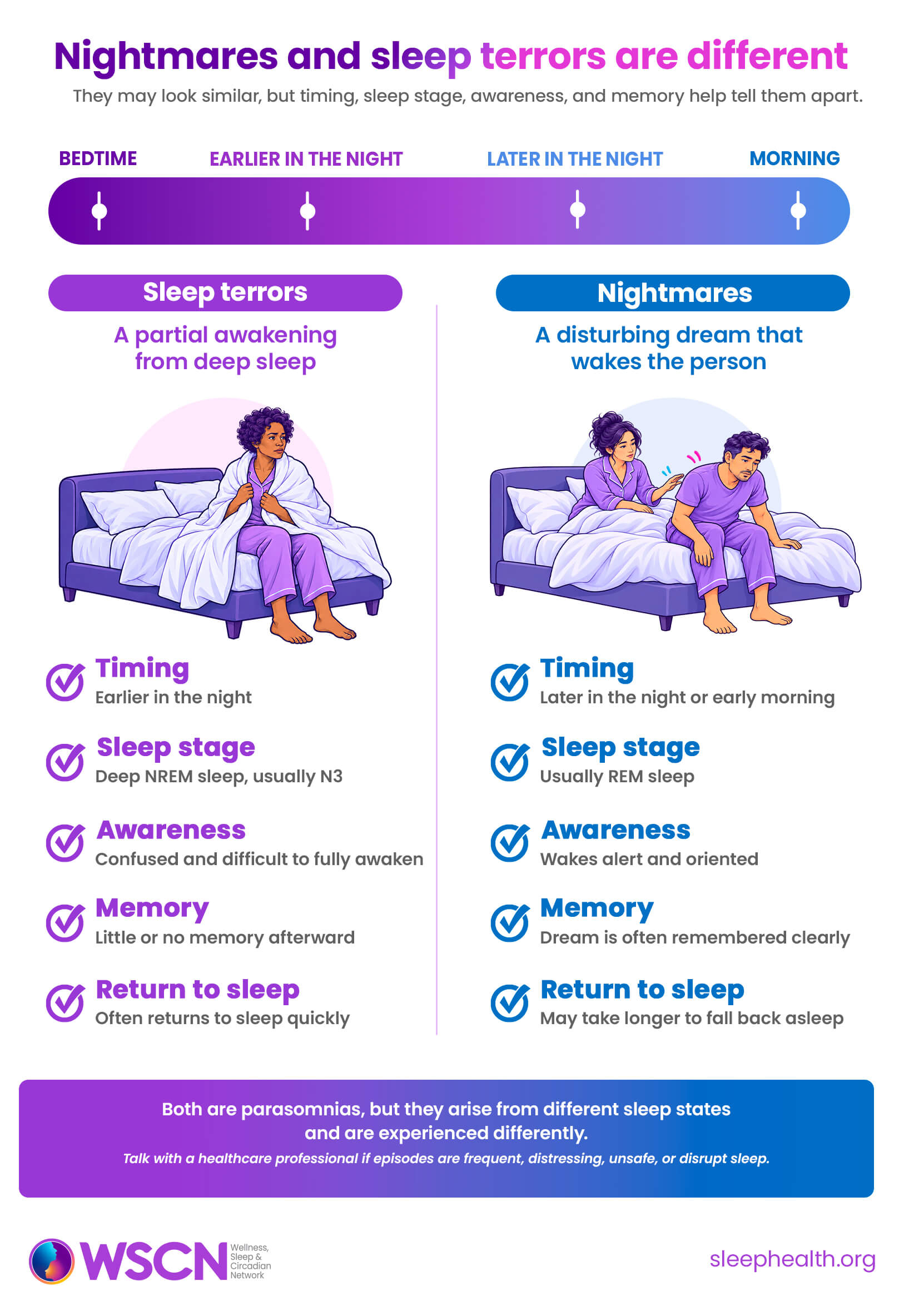
It is important to note that sleep terrors are different from nightmares. Nightmares usually arise from REM sleep and are often remembered as vivid dreams.
On the other hand, sleepwalking and sleep terrors arise during deep NREM sleep and more often involve confusion, limited responsiveness, and little memory of the event upon waking. Adult events deserve careful assessment when they are new, frequent, unusual, or unsafe, because other sleep disorders or medical conditions can look similar.
Signs and symptoms
Nighttime symptoms
A person can experience a range of events, including:
- Sitting up, speaking unclearly, or appearing confused
- Walking, running, moving objects, eating, dressing, or attempting to leave the room
- Have a glassy-eyed, staring vacant expression
- Screaming, crying out, breathing quickly, sweating, or having a racing heart
- Resisting comfort, pushing someone away, or becoming difficult when redirected
- Returning to bed without becoming fully awake
- Having little or no memory of the event the next morning
Episodes may last seconds to several minutes and may occur alone or in clusters.
Important Note: Forceful waking or restraint can increase confusion; unless there is immediate danger, calm redirection is usually safer and more effective.
Daytime and household effects
The event may be brief, but its effects can reach across the full day. Fragmented sleep may contribute to fatigue, sleepiness, reduced concentration, irritability, or poorer work and driving safety. Fear of another episode can change bedtime routines, travel, intimacy, and willingness to sleep away from home. Bed partners and household members may also lose sleep or feel anxious about safety.
Screening and diagnosis
Diagnosis usually begins with a detailed clinical history. A clinician may ask what happens, when and how often it occurs, whether the person leaves bed, whether there is dream recall, and how the event affects daytime function and household safety. A sleep diary, a bed partner’s description, or a safely recorded home video may help reveal patterns.
Assessment may review sleep timing and duration; shift work or travel; stress and trauma; alcohol and other substances; medications and supplements; snoring or breathing pauses; restless legs symptoms; and neurological history.
Looking across all 24 hours can show whether episodes follow short sleep, irregular timing, illness, pain, intense stress, or untreated sleep disruption.
An overnight video sleep study is not always needed. Video polysomnography with brain-wave monitoring may be recommended when events are frequent, injurious, highly repetitive, begin in adulthood, or could represent seizures, REM sleep behavior disorder, sleep apnea, or another condition.
When to talk with a healthcare professional
A person does not need to know the name or exact nature of a condition before asking for help. If a person experiences any of the symptoms above, it is appropriate to discuss them with a healthcare professional.
Red Flag: Seek urgent medical care if symptoms or sleep loss are affecting a person’s ability to drive or work safely, or is causing severe distress or thoughts of self-harm.
What to bring to a doctor’s visit
A primary care physician is a good place to start for a sleep disorder evaluation. They can conduct preliminary screenings and recommend next steps for diagnosis. It can be helpful to bring information to an initial visit: try using WSCN’s How to talk to your primary care clinician about sleep problems checklist.
Causes, risk factors, and health implications
Causes and risk factors
Sleepwalking and sleep terrors rarely have one simple cause. Factors that may increase vulnerability include:
- Biology and family history: Disorders of arousal can run in families
- Sleep pressure and timing: Sleep deprivation, irregular schedules, shift work, and jet lag may make partial arousals more likely
- Sleep fragmentation: Obstructive sleep apnea, restless legs symptoms, periodic limb movements, pain, noise, or caregiving interruptions may trigger arousals
- Stress and health changes: Acute stress, trauma symptoms, anxiety, fever, illness, and major life changes may contribute
- Alcohol, substances, and medications: Alcohol, sedatives, withdrawal, and some psychiatric or neurological medicines may alter sleep or arousal
Health implications
Evidence for direct long-term heart or metabolic effects from these parasomnias is limited. The clearest concerns come from injury, disrupted sleep, and untreated contributing conditions.
- Safety: Falls, collisions, wandering, driving, or defensive movements can injure the person or someone nearby
- Sleep and daytime function: Repeated disruption may worsen alertness, concentration, work performance, and driving safety
- Mental health: Fear of sleep, shame, anxiety, trauma distress, or depression may worsen without support
- Relationships and quality of life: Household sleep loss, worry, and changing sleeping arrangements can affect connection and wellbeing
Treatment and management
Treatment is individualized according to frequency, injury risk, contributing conditions, and the person’s goals. The aim is not only fewer events, but also safer nights, more stable sleep, better daytime function, and greater confidence for the household.
Safety planning
Helpful changes may include clearing floors, padding sharp furniture, securing windows and exterior doors, blocking unsafe stair access, avoiding top bunks, lowering the bed when falls are possible, and securely storing weapons or hazardous items. Door alarms or motion alerts may help when wandering is a risk.
Addressing triggers and related conditions
Care may include both daytime and nighttime supports to manage triggers. Supports can include providing enough sleep opportunity, keeping sleep and wake times regular, reducing alcohol, managing stress, and treating other sleep disorders, especially sleep apnea. Medication and supplement reviews should include possible benefits, risks, interactions, and next-day effects.
Scheduled awakenings may help when episodes occur predictably. Behavioral treatment may combine education, relaxation, stress-focused or trauma-informed therapy, and treatment for insomnia or anxiety. Evidence for medication is limited, but a clinician may consider it for frequent, severe, or injurious episodes after weighing individual risks and benefits.
Living with sleepwalking and sleep terrors
A shared household plan can reduce risk, blame and uncertainty. It may help to record episode details and daytime activities for a week or two in a sleep diary, to link episodes to possible triggers. During an event, household members can focus on immediate safety and calm redirection rather than arguing with or forcefully restraining the person.
Research and what we are still learning
Adult NREM parasomnias remain less studied than childhood cases. Research is examining how genetics, sleep pressure, brain arousal networks, stress, and other sleep disorders interact. Larger treatment studies are needed because much current evidence comes from observational studies, small clinical samples, and case series.
Castelnovo, A., Lopez, R., Proserpio, P., et al. (2018). NREM sleep parasomnias as disorders of sleep-state dissociation. Nature Reviews Neurology, 14(8), 470–481. https://doi.org/10.1038/s41582-018-0030-y
Derry, C. P., Harvey, A. S., Walker, M. C., et al. (2009). NREM arousal parasomnias and their distinction from nocturnal frontal lobe epilepsy: A video EEG analysis. Sleep, 32(12), 1637–1644. https://doi.org/10.1093/sleep/32.12.1637
Drakatos, P., Marples, L., Muza, R., et al. (2019). Video polysomnographic findings in non-rapid eye movement parasomnia. Journal of Sleep Research, 28(2), e12772. https://doi.org/10.1111/jsr.12772
Lopez, R., Jaussent, I., Scholz, S., et al. (2013). Functional impairment in adult sleepwalkers: A case-control study. Sleep, 36(3), 345–351. https://doi.org/10.5665/sleep.2446
Mainieri, G., Loddo, G., Provini, F., & Nobili, L. (2023). Diagnosis and management of NREM sleep parasomnias in children and adults. Diagnostics, 13(7), 1261. https://doi.org/10.3390/diagnostics13071261
Mundt, J. M., & Baron, K. G. (2021). Integrative behavioral treatment for NREM parasomnias: A case series. Journal of Clinical Sleep Medicine, 17(6), 1313–1316. https://doi.org/10.5664/jcsm.9186
This article is for educational purposes only and is not intended to replace professional medical advice, diagnosis, or treatment. Speak with a qualified healthcare professional about questions or concerns related to your sleep. Read full medical disclaimer
