
Across The Body
Mental Health, Circadian Rhythms and Sleep
Mental health, sleep, and circadian rhythms are closely connected. Mental health conditions can disrupt sleep and alter daily routines. But the relationship also works in the other direction. Poor sleep or disrupted body rhythms can affect mood, thinking, emotional regulation, and other mental health symptoms.
These connections extend across the full 24-hour day. Changes in nighttime sleep can affect how someone feels and functions the next day. Daily activity and exposure to daylight can also influence the following night’s sleep.
Looking across the full day and night can help reveal patterns that might otherwise go unnoticed. Sleep problems do not have to be accepted as an unavoidable part of a mental-health condition. Recognizing these connections can create opportunities for better care and treatment.
Overview
- Mental-health conditions can affect sleep, while persistent sleep problems may contribute to mental-health symptoms.
- Depression, anxiety, PTSD, ADHD, and several other conditions can involve changes in sleep or daily circadian rhythms.
- Poor sleep can affect emotional regulation and make concentration more difficult.
- Circadian disruption can affect mood, alertness, and cognition independently from its effects on sleep.
- New or worsening sleep problems can sometimes signal a mental-health concern or a separate sleep disorder.
- Effective treatments are available for many sleep problems. Improving sleep can also support mental-health outcomes.
- Looking across the full 24 hours can help identify patterns and opportunities for optimal care and wellbeing.
ON THIS PAGE
-
How sleep, circadian rhythms and mental health are connected
-
Mental-health conditions and sleep
-
How poor sleep can affect mental health
-
How circadian disruption can affect mental health
-
What can change and what can be treated
-
OWN ALL 24 HOURS: Looking at the full day and night
-
When sleep problems need a closer look
-
What to track and discuss with your care team
How sleep, circadian rhythms and mental health are connected
Sleep is a state the brain and body move through each day. Circadian rhythms provide the timing system around it.
A small area of the brain called the suprachiasmatic nucleus, or SCN, serves as the body’s central clock. It receives light information from the eyes and uses it to help keep the body synchronized with day and night. This timing system helps organize sleep and wake cycles. It also helps coordinate hormones, body temperature, alertness, and brain activity.
Sleep adds another layer. The longer we stay awake, the more pressure builds to sleep. During a normal day, this sleep pressure works together with the circadian system. The circadian clock helps us stay awake during the day and supports sleep at night.
Both systems interact with brain processes involved in emotion, memory, attention, stress, and reward. This helps explain why sleep and circadian disruption can affect mental health rather than merely make someone tired.
Sleep and circadian rhythms therefore provide two connected pathways through which mental health can be affected. Understanding both can help explain why someone’s symptoms may change after a difficult night or at different times of day.
Mental-health conditions and sleep
These conditions can share similar sleep problems, but the causes may differ. A person may also have a separate sleep disorder, such as insomnia or sleep apnea, that needs assessment and treatment in its own right.
How poor sleep can affect mental health
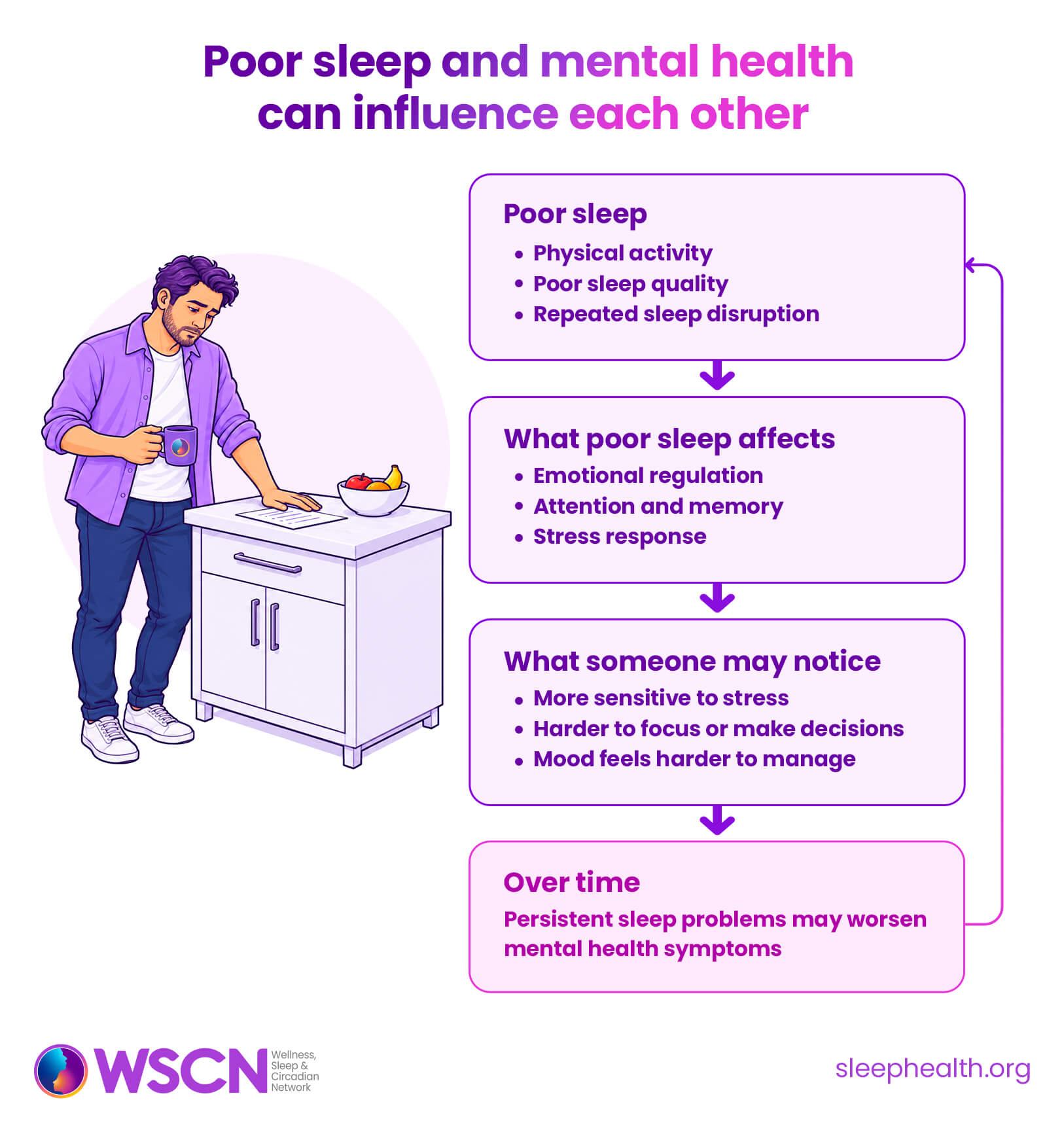
When sleep is too short or repeatedly interrupted, it can become harder to manage emotions. Research suggests that sleep loss can heighten reactions to negative experiences and reduce responses to positive ones. This may make everyday challenges feel more difficult.
Thinking can be affected as well. Sleep loss can reduce attention and make it harder to solve problems or make decisions. Memory can also suffer. These changes may make existing mental health symptoms harder to manage.
Poor sleep can also affect the body’s stress systems. Studies have linked sleep disruption to changes in stress hormones and inflammation. These same biological systems are involved in several mental health conditions, although researchers are still working out exactly how these connections operate.
A single bad night is not, by itself, a sign of a mental-health disorder. Persistent sleep problems deserve attention, particularly when they affect mood or daily life.
How circadian disruption can affect mental health
Circadian rhythms influence more than sleep. They also help shape changes in alertness and mood across the day. Researchers have found that the body’s internal timing system can affect mood independently of how long someone has been awake.
Circadian disruption can make someone feel alert when they need to sleep or sleepy when they need to be awake. This can happen when work or other demands regularly conflict with the body’s internal timing. Mood and alertness may also change at different times of day.
Researchers are studying whether adjusting circadian timing can improve mental-health symptoms. Some studies suggest benefits for selected people with depression, particularly when their internal timing is delayed. However, these approaches do not work the same way for everyone.
What can change and what can be treated
Sleep problems are an important part of mental-health care, and many can be treated. Improving sleep can do more than make nights easier. It can also help people feel and function better during the day.
Persistent insomnia has an effective treatment: cognitive behavioral therapy for insomnia (CBT-I). It helps people change thoughts and habits that keep sleep difficulties going. A research review of randomized trials found that sleep treatments that successfully improved sleep also improved mental-health outcomes. Benefits were particularly clear for symptoms of depression and anxiety.
Once a sleep problem has been identified, treatment can be matched to its cause. Recurring nightmares may respond to therapies that help people rehearse a less distressing version of a dream. A separate sleep disorder may need its own treatment, even when the person is already receiving mental-health care.
Circadian problems offer another opportunity for care. Depending on the individual, a clinician may recommend carefully timed light exposure or gradual changes to sleep timing. These approaches can help bring daily rhythms into better alignment, when appropriately tailored to the person. Light-based treatment requires particular care in people with bipolar disorder because it can sometimes trigger mania or hypomania.
The goal is to identify which sleep or circadian problems can be addressed and find treatments that work for the individual. Sleep and circadian care can be part of mental-health treatment, creating more opportunities for improvement across the full 24 hours.
OWN ALL 24 HOURS: Looking at the full day and night
Understanding sleep and mental health means looking beyond bedtime. A short record across several days can show whether difficult nights coincide with changes in mood or daytime energy. It can also reveal whether symptoms tend to worsen at particular times.
These patterns can help identify opportunities for change. Someone may find that long afternoon naps make it harder to sleep at night. Another person may notice that a change in medication coincided with new sleep problems. Some patterns may point to a sleep disorder that needs treatment.
The goal is not to create a perfect schedule. It is to find a pattern that works for you. Understanding your own 24-hour rhythm can help you recognize changes, identify what you can influence, and work with your care team to find the right support.
When sleep problems need a closer look
Changes in sleep can sometimes be an early sign of a mental-health condition or a warning that existing symptoms are worsening. For example, persistent insomnia may occur before depression develops. A sudden reduction in the need for sleep can also be an early sign of a manic episode in someone with bipolar disorder. Sleep changes alone cannot diagnose a mental-health condition, but significant or sudden changes should be discussed promptly with a healthcare professional.
At the same time, a mental-health condition does not explain every sleep problem. Sometimes, a separate sleep disorder is present and needs its own treatment.
For example, loud snoring, waking up gasping, or pauses in breathing during sleep may be signs of obstructive sleep apnea, a condition in which breathing repeatedly stops or becomes restricted during sleep. Frequent nightmares can also be a problem in their own right, even when other mental-health symptoms are improving.
Other factors may contribute. Unusual daytime sleepiness may be a medication side effect. Consistently struggling to fall asleep until very late may indicate a problem with the timing of the body clock.
Recognizing changes in sleep can help identify emerging mental-health concerns or a separate sleep disorder. Understanding the cause gives the care team more opportunities to provide the right support and treatment.
What to track and discuss with your care team
A short record can help show how sleep and symptoms fit together across the day.
- Changes in mental-health symptoms, including when mood or anxiety improves or worsens
- Unusual changes in energy or the need for sleep
- Nightmares or other distressing nighttime experiences
- Mental-health medication timing and recent medication changes
- Other sleep and daily patterns, including bedtime and wake time, night wakings, naps, daytime sleepiness, activity and daylight exposure
Tracking cannot diagnose a mental health or sleep disorder. It can help a healthcare professional identify patterns and determine whether a sleep or circadian problem needs further assessment.
Cajochen, C., & Schmidt, C. (2025). The circadian brain and cognition. Annual Review of Psychology, 76, 115–141. https://doi.org/10.1146/annurev-psych-022824-043825
Dollish, H., Tsyglakova, M., & McClung, C. A. (2024). Circadian rhythms and mood disorders: Time to see the light. Neuron, 112(1), 25–40. https://doi.org/10.1016/j.neuron.2023.09.023
Meyer, N., Lok, R., Schmidt, C., et al. (2024). The sleep–circadian interface: A window into mental disorders. Proceedings of the National Academy of Sciences, 121(9), e2214756121. https://doi.org/10.1073/pnas.2214756121
Roenneberg, T., Foster, R. G., & Klerman, E. B. (2022). The circadian system, sleep, and the health/disease balance: A conceptual review. Journal of Sleep Research, 31(4), e13621. https://doi.org/10.1111/jsr.13621
Scott, A. J., Webb, T. L., Martyn-St James, M., et al. (2021). Improving sleep quality leads to better mental health: A meta-analysis of randomised controlled trials. Sleep Medicine Reviews, 60, 101556. https://doi.org/10.1016/j.smrv.2021.101556
Sheaves, B., Rek, S., & Freeman, D. (2023). Nightmares and psychiatric symptoms: A systematic review of longitudinal, experimental, and clinical trial studies. Clinical Psychology Review, 100, 102241. https://doi.org/10.1016/j.cpr.2022.102241
So, C. J., Miller, K. E., & Gehrman, P. R. (2023). Sleep disturbances associated with posttraumatic stress disorder. Psychiatric Annals, 53(11), 491–495. https://doi.org/10.3928/00485713-20231012-01
Vestergaard, C. L., Skogen, J. C., Hysing, M., et al. (2024). Sleep duration and mental health in young adults. Sleep Medicine, 115, 30–38. https://doi.org/10.1016/j.sleep.2024.01.021
Wescott, D. L., Hasler, B. P., Foust, J. E., et al. (2025). Circadian realignment and depressed mood: A systematic review. Sleep Medicine Reviews, 79, 102022. https://doi.org/10.1016/j.smrv.2024.102022
This article is for educational purposes only and is not intended to replace professional medical advice, diagnosis, or treatment. Speak with a qualified healthcare professional about questions or concerns related to your sleep. Read full medical disclaimer
