
Sleep Problems & Disorders

Exploding Head Syndrome

Exploding head syndrome is a sleep-related experience in which a person suddenly hears or senses a loud bang, crash, electrical sound, or other burst of sensation while falling asleep or waking up. The sound does not come from the environment around the person, but it can feel very real.

It is a type of parasomnia, meaning an unusual event during sleep or a sleep–wake transition. Typical episodes are brief, painless, and not known to damage the brain or hearing. Even so, they can be frightening and can lead to worry about sleep. 

Overview

  • Exploding head syndrome involves a sudden perceived noise or sensory burst during the transition into or out of sleep
  • Episodes are usually painless and last less than a second, although fear and alertness may continue afterward
  • Some adults also notice a flash of light, muscle jerk, electrical sensation, or racing heartbeat
  • The condition itself is generally considered benign, but repeated episodes can disrupt sleep and daytime function
  • Short sleep, irregular schedules, stress, and other sleep problems may contribute to exploding head syndrome for some people
  • Education, reassurance, steadier sleep, and evaluation of related conditions can help

About exploding head syndrome

Exploding head syndrome, sometimes called episodic cranial sensory shock, occurs at the boundary between sleep and wakefulness. A person may perceive a sudden loud noise inside the head. Some people also report a flash of light, a sensation of energy, or a body jerk.

The episode is not caused by an actual noise or occurrence in the room. The main effects are typically a startle response, fear, confusion, and difficulty returning to sleep. 

Exploding head syndrome was once described as rare. Newer studies suggest that occasional episodes are more common than previously thought, including among younger adults. Many people may not report symptoms because episodes are infrequent, they do not know the experience has a name, or they worry it will sound unusual.

The exact mechanism is unknown. One theory is that brain networks involved in hearing, sensory processing, movement, and arousal do not disengage or reactivate in their usual sequence during a sleep–wake transition, creating a brief perception of sound or light without an external source.

Signs and symptoms

During an episode

A person may experience:

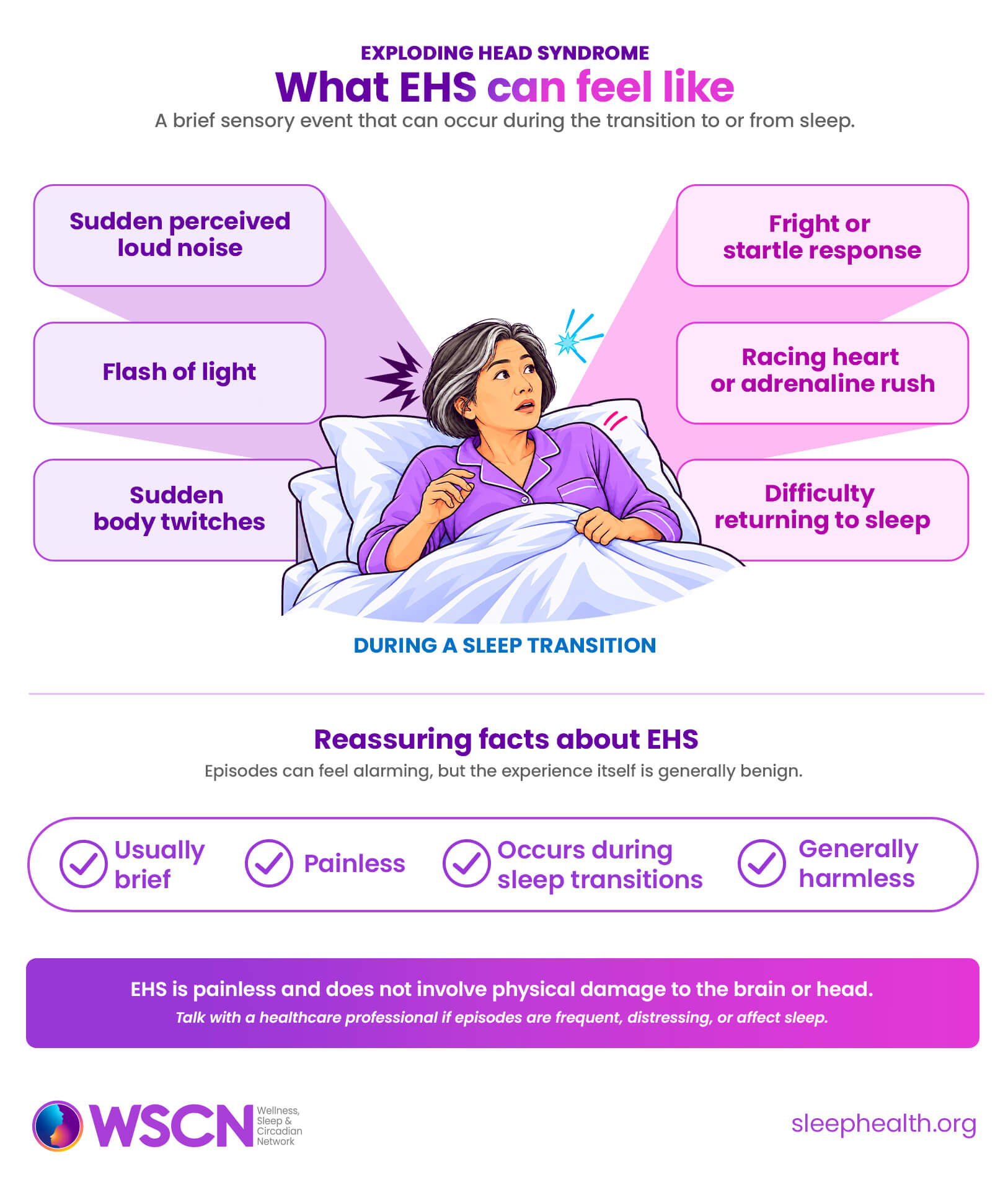
  • A sudden loud noise, bang, crash, snap, roar, or buzzing sound
  • An explosive sensation in the head
  • A flash of light or visual burst
  • A muscle twitch, body jolt, or jump-start
  • Sudden startle, fear, alarm, or confusion
  • A rapid heartbeat or rush of adrenaline
  • Brief difficulty returning to sleep

Episodes usually happen while falling asleep or waking. They are generally very short, only a few seconds for the actual perceived sound or shock, and the person can usually remember what occurred.

After an episode

Although the sensory event is brief, its effects can continue into the night and following day. A person may become watchful at bedtime, delay sleep, wake a bed partner, or avoid naps. Resulting sleep loss may contribute to fatigue, sleepiness, reduced concentration, mood changes, and less confidence in sleeping.
Screening and diagnosis

Exploding head syndrome is usually identified from the person’s description and sleep history. A clinician may ask what the event feels like, when it occurs, how often it happens, and whether it includes pain, weakness, confusion, fainting, loss of awareness, or unusual movements. The wider 24-hour history matters, including sleep timing and duration, daytime sleepiness, stress, work schedule, naps, medication changes, substances, and symptoms of other sleep disorders.

A sleep study is not routinely needed for a typical isolated episode. Polysomnography, an electroencephalogram (EEG), neurological assessment, hearing evaluation, imaging, or other testing may be considered when the pattern is unclear or another condition is suspected.

When to talk with a healthcare professional

A person does not need to know the name or exact nature of a condition before asking for help. If a person experiences any of the symptoms above, it is appropriate to discuss them with a healthcare professional. 

Red Flag: Exploding head syndrome is typically brief and painless. It does not cause loss of consciousness, physical injury, or hearing loss, and it is different from hearing voices while fully awake. Seek urgent medical care for symptoms accompanied by:

  • A sudden or severe headache or other acute pain
  • A seizure while awake
  • New hearing changes during the day
  • New weakness, loss of movement, or difficulty speaking
  • Severe distress or thoughts of self-harm
  • Sleep loss that makes driving or working unsafe

New, painful, prolonged, worsening, or changing symptoms should also be assessed by a healthcare professional. Neurological, headache, hearing, panic-related, and other sleep conditions can cause similar experiences but may require different treatment.

What to bring to a doctor’s visit

A primary care physician is a good place to start for a sleep disorder evaluation. They can conduct preliminary screenings and recommend next steps for diagnosis. It can be helpful to bring information to an initial visit: try using WSCN’s How to talk to your primary care clinician about sleep problems checklist.

Causes, risk factors, and health implications

Causes and risk factors

There is no single established cause for exploding head syndrome. Research has identified associations and possible theories, but many studies are observational and cannot prove that one particular factor causes episodes. One theory is that brain networks involved in hearing, sensory processing, movement, and arousal do not disengage or reactivate in their usual sequence during a sleep–wake transition, leading to abnormal perceptions such as loud noises, flashes of light or body jerks.

Possible contributors include:

  • Sleep loss or irregular timing: Short sleep, inconsistent bedtimes, jet lag, shift work, and disrupted routines may make sleep–wake transitions less stable.
  • Stress and anxiety: Episodes may become more noticeable or distressing during periods of higher stress.
  • Inner ear injury or damage: May cause distorted sounds or other unusual hearing sensations without external sound sources.
  • Other sleep problems: Insomnia, sleep paralysis, obstructive sleep apnea, and other parasomnias may occur alongside exploding head syndrome.
  • Medications and substances: Prescription changes, alcohol, nicotine, caffeine, cannabis, and withdrawal may affect sleep continuity or arousal. Evidence for specific triggers remains limited.
  • Individual vulnerability: Differences in individual sensory processing, arousal, or sleep–wake regulation may contribute.

Long-term health implications

The brief event itself is not known to impact health or wellbeing in any way. Health effects are more likely to arise from ongoing distress, sleep disruption, or an untreated related condition.

  • Mental health: Repeated frightening episodes may contribute to bedtime anxiety, panic, trauma-related distress, or low mood.
  • Sleep health: Fear and sleep avoidance may reinforce insomnia, irregular timing, and chronic sleep loss.
  • Daytime function and safety: Poor sleep may reduce alertness, concentration, mood stability, work performance, and driving safety.
  • Heart and metabolic health: Exploding head syndrome itself has not been shown to cause cardiovascular or metabolic disease. However, chronic sleep loss, circadian disruption, stress, or untreated sleep apnea may carry these risks and should not be overlooked.
  • Missed diagnosis: Assuming every unusual nighttime event is exploding head syndrome may delay recognition of another treatable sleep, neurological, hearing, or mental health condition.

Treatment and management

Treatment depends on frequency, distress, daytime effects, and whether another condition is contributing. Many adults need only a clear explanation and reassurance that their health is not being impacted. Episodes of exploding head syndrome are recognized sleep-related events and are not a sign of poor discipline or lack of effort.

Supporting steadier sleep

A clinician may recommend allowing enough time for sleep, keeping sleep and wake times reasonably consistent, and addressing insomnia or schedule disruption. Reviewing caffeine, alcohol, nicotine, cannabis, medications, and supplements may identify changes that coincide with episodes. These steps support sleep health but are not a guaranteed cure.

Medication is not usually the first approach for isolated episodes. Published reports describe medications used in selected cases, but evidence is limited and no medication has been established as a standard treatment. Decisions should be individualized with a clinician.

Related conditions such as insomnia, obstructive sleep apnea, anxiety, trauma-related symptoms, or medication effects may need their own assessment and treatment. The goal is broader than reducing episodes: it includes restoring sleep confidence, protecting daytime alertness, and supporting a stable routine across the full day.

Responding to an episode

A simple plan may reduce panic:

  • Name the experience and remember that a typical episode is brief and does not pose any external or medical danger
  • Check the environment once if needed, then avoid repeated checking
  • Use slow breathing or another familiar grounding strategy
  • Keep lighting low to make returning to sleep easier
  • Record the episode later rather than staying awake to analyze it

Living with exploding head syndrome

Tracking can help identify patterns without turning sleep into a constant monitoring task. Useful details include episode timing, sleep duration, naps, schedule changes, stress, sleeping position, medications, substances, and symptoms such as snoring, gasping, nightmares, panic, or daytime sleepiness.

A bed partner can respond calmly and help confirm that there was no outside noise. A shared plan may reduce alarm for both people. If episodes continue to disrupt sleep or daily life, further evaluation is reasonable.

Research and What We Are Still Learning

Researchers are still studying how common exploding head syndrome is, why episodes recur for some people, and which treatments are most effective. Survey studies have found overlap with insomnia symptoms, sleep paralysis, stress, and mental health symptoms, but these links do not establish cause and effect.

Objective recordings are uncommon because episodes are brief and unpredictable. Small case reports have documented events during polysomnography, while larger community studies are improving estimates of prevalence and impact. Future research needs to measure outcomes that matter to people, including fear of sleep, sleep confidence, daytime function, and treatment burden.

References

Denis, D., Poerio, G. L., & Derveeuw, S. (2025). Prevalence and impact of exploding head syndrome in a Japanese community sample. Sleep, 48(5), zsaf007. https://doi.org/10.1093/sleep/zsaf007

Kirwan, E., & Fortune, D. G. (2021). Exploding head syndrome, chronotype, parasomnias and mental health in young adults. Journal of Sleep Research, 30(2), e13131. https://pubmed.ncbi.nlm.nih.gov/32282101/

Nakayama, M., Nakano, N., Mihara, T., et al. (2021). Two cases of exploding head syndrome documented by polysomnography that improved after treatment. Journal of Clinical Sleep Medicine, 17(1), 103–106. https://pmc.ncbi.nlm.nih.gov/articles/PMC7849637/

Sharpless, B. A. (2018). Characteristic symptoms and associated features of exploding head syndrome in undergraduates. Cephalalgia, 38(3), 595–599. https://pubmed.ncbi.nlm.nih.gov/28385085/

Sharpless, B. A., Denis, D., Poerio, G. L., et al. (2020). Exploding head syndrome: Clinical features, theories about etiology, and prevention strategies in a large international sample. Sleep Medicine, 75, 251–255. https://pubmed.ncbi.nlm.nih.gov/32862013/

Wróbel-Knybel, P., & Kister, K. (2025). Exploding Head Syndrome – A Puzzling Parasomnia: A Literature Review. Current Problems of Psychiatry, 26, 85-99. https://doi.org/10.12923/2353-8627/2025-0008


Medical disclaimer
This article is for educational purposes only and is not intended to replace professional medical advice, diagnosis, or treatment. Speak with a qualified healthcare professional about questions or concerns related to your sleep. Read full medical disclaimer

Related pages