
Across The Body

Chronotherapy

Cancer treatments are usually chosen based on the type of cancer, how advanced it is, and factors specific to the person receiving treatment. Chronotherapy adds another consideration: timing.

Many body processes change naturally across the day and night. These approximately 24-hour patterns are known as circadian rhythms. These rhythms help regulate sleep and wakefulness. They also influence how the body processes medications, how cells grow and repair themselves, and how the immune system responds.

Chronotherapy uses this biological timing when planning treatment. The aim is to identify times when cancer cells may be more vulnerable, healthy tissues may be better able to tolerate treatment, or both. Chronotherapy is not a separate type of cancer treatment. It is a way of considering when existing treatments are delivered.

Research into chronotherapy is growing, but it is not yet standard practice for most cancer treatments. The best timing can also vary by treatment and by individual. This page explains what chronotherapy is, how the body clock can affect cancer treatment, and how biological timing may become part of more personalized cancer care. Understanding these connections can also help people ask more informed questions about treatment timing and how their own daily rhythms fit into cancer care.

Overview

  • Chronotherapy means timing treatment according to biological rhythms
  • The body’s circadian rhythms affect many processes involved in cancer treatment
  • Treatment timing may influence how well some treatments work or how well they are tolerated
  • Chronotherapy has been studied most extensively with chemotherapy. Research is also expanding into immunotherapy, radiotherapy, and other treatments
  • The best treatment time may depend on the cancer, the treatment being used, and the individual
  • Understanding your own sleep-wake patterns, treatment schedule, and daily rhythms can help make conversations about treatment timing more specific and useful
  • Cancer treatment schedules should not be changed without discussing them with the cancer care team

What is chronotherapy?

The body’s circadian system is its internal timing system. It helps organize many body processes across the day and night. Light and darkness are important signals for this system. Sleep, activity, meals, and other daily routines are also connected to it.

Many body processes follow approximately 24-hour rhythms. These include changes in body temperature, hormone levels, immune activity, and the way the body processes medicines.

Chronotherapy uses these natural changes in biological activity when considering when a treatment is given. In cancer care, the idea is that the same treatment may affect cancer cells and healthy tissues differently depending on when it is delivered.

Chronotherapy can take different forms. A cancer medicine may be given at a specific time of day. An infusion pump can also be programmed to deliver different amounts of medicine at different times across the day and night. In the future, treatment timing may increasingly be matched to each person’s biological rhythm rather than simply to the time shown on the clock.
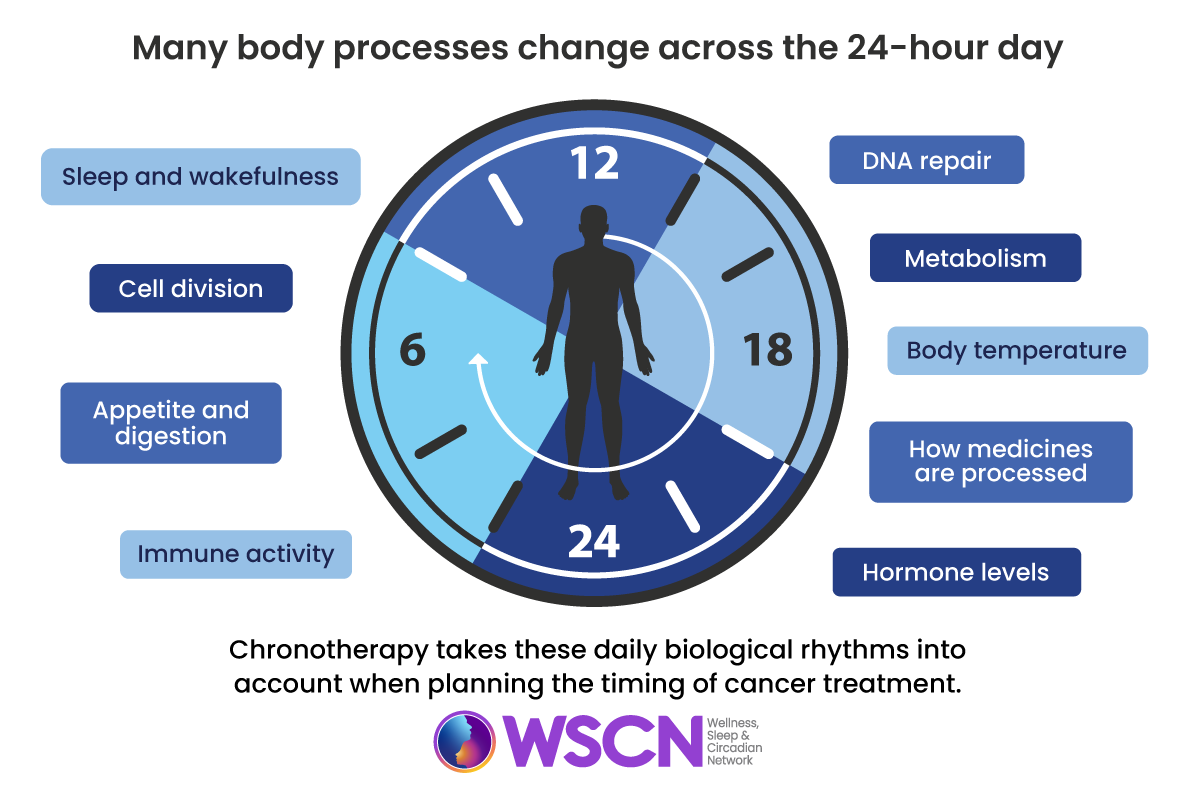
Many body processes change across the 24-hour day. Chronotherapy takes these daily biological rhythms into account when planning the timing of cancer treatment.

How the body clock can influence cancer treatment

Cancer treatments affect both cancer cells and healthy tissues. Because many body processes change across the 24-hour day, the effects of treatment can also vary depending on when it is given.

Circadian rhythms may influence treatment in three main ways: how the body handles medicines, how sensitive cells are to treatment, and how the immune system responds.

The body handles medicines differently across the day

Once a cancer medicine enters the body, it is distributed to the tissues where it acts. The body then breaks it down and eventually removes it. 

The liver, kidneys, and other tissues involved in these processes change their activity across the day. Some of the proteins that help break down medicines also follow daily rhythms. As a result, the same dose may be processed somewhat differently depending on when it is given.

This may affect how much medicine reaches different tissues and how well the body tolerates the treatment.

Cancer cells and healthy tissues can be more or less sensitive at different times

Cell activity changes across the day. This includes cell division and DNA repair, the processes cells use to copy and repair their genetic material. Many cancer treatments act on these same processes. Chemotherapy is designed to kill cancer cells or stop them from growing and dividing, while radiotherapy uses radiation to damage cancer-cell DNA so the cells can no longer grow normally.

Cancer cells do not always follow the same rhythms as healthy tissue. Their rhythms may be altered or disrupted, which creates the possibility of giving treatment when cancer cells are more vulnerable while healthy cells are better able to recover.

Immune activity also changes across the 24-hour day

The immune system follows strong daily rhythms. Immune cells move between the blood and tissues at different rates across the day, and their activity can also change.

This is especially important for immunotherapy, which helps the immune system recognize and attack cancer cells. Research has shown that the number and activity of cancer-fighting immune cells inside tumors can change across the circadian cycle. Treatment timing may therefore influence how strongly the immune system responds to some immunotherapies.
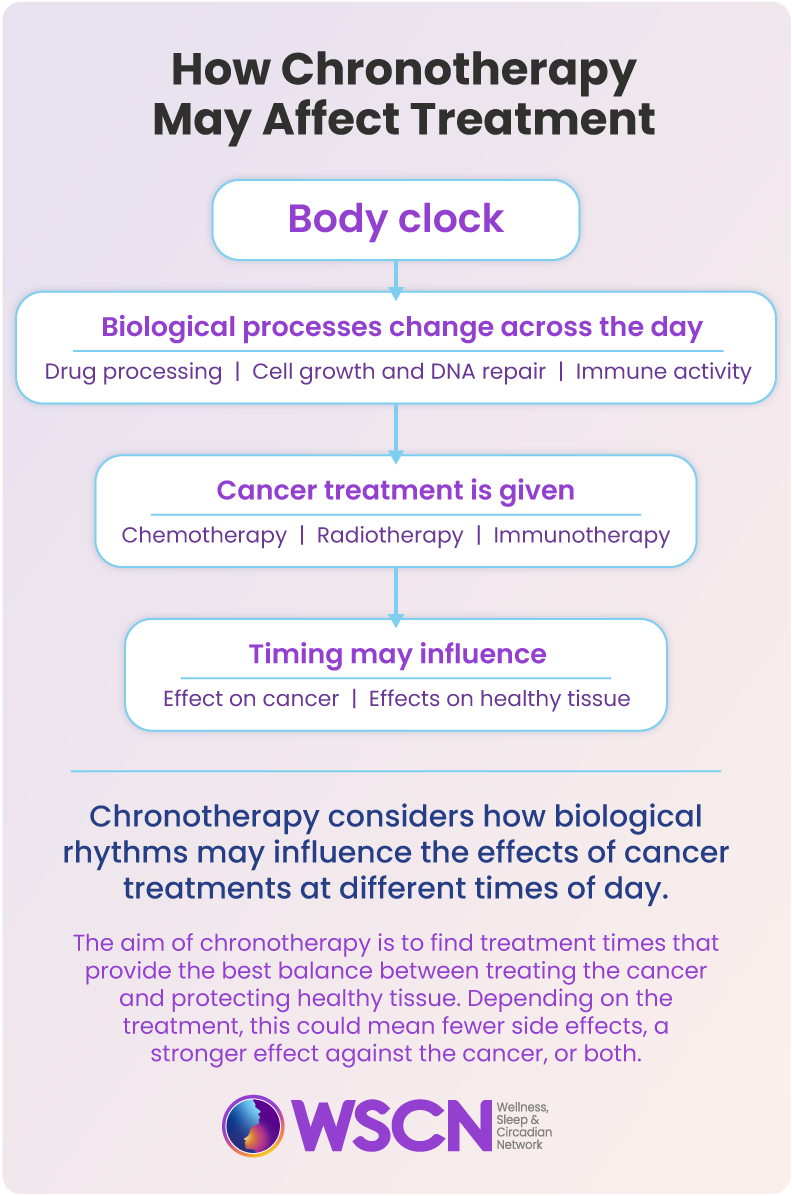
The aim of chronotherapy is to find treatment times that provide the best balance between treating the cancer and protecting healthy tissue. Depending on the treatment, this could mean fewer side effects, a stronger effect against the cancer, or both.

Chronotherapy across cancer treatments

Chronotherapy can be applied in different ways depending on the type of cancer treatment and how that treatment works.

Chemotherapy

Chemotherapy is the area in which chronotherapy has been studied the longest. Some chemotherapy medicines have been given at specific times of day. Others have been delivered through programmable pumps that adjust the amount of medicine given throughout the day and night.

One aim is to deliver treatment when healthy tissues are better able to tolerate it, without reducing its effect against the cancer. A systematic review of 18 randomized clinical trials involving more than 2,500 people found that timed chemotherapy reduced certain treatment-related side effects in many of the studies while maintaining the treatment’s effect against cancer.

Radiotherapy

Radiotherapy uses high-energy radiation to damage the DNA of cancer cells, which can stop them from growing and dividing.

Because the body’s ability to respond to and repair cell damage changes across the day, researchers have studied whether the timing of radiotherapy could influence treatment response or side effects.

Studies have tested different radiotherapy times in several types of cancer, with mixed results. There is currently no single treatment time that applies to radiotherapy as a whole.

Immunotherapy

Immunotherapy helps the immune system fight cancer. One major group of these treatments is called immune checkpoint inhibitors. These medicines block signals that can prevent immune cells from attacking cancer effectively. 

The timing of immunotherapy is now one of the fastest-growing areas of chronotherapy research. Laboratory research has shown that immune activity inside tumors changes across the circadian cycle. In one study, the number and activity of T cells, immune cells that can attack cancer, changed with time of day.

Some studies in people with cancer have found associations between the timing of immune checkpoint inhibitor infusions and treatment outcomes. However, findings are not yet consistent enough to establish a best treatment time.

Other cancer treatments

Researchers are also investigating chronotherapy with targeted cancer medicines, hormone treatments, and cell therapies such as CAR-T therapy, in which a person’s T cells are modified so they can recognize and attack cancer cells.

These treatments work in very different ways, so the same timing approach is unlikely to apply to all of them. The goal is to understand whether there may be a better biological time for a particular treatment and patient.

24-hour view: Clock time and biological time are not the same

People differ in their natural circadian timing. This means that the same clock time may represent a different biological time for different people.

Researchers are studying ways to measure this more precisely using signals such as sleep and activity patterns, melatonin, body temperature, and blood-based markers.

This may eventually allow chronotherapy to be tailored to an individual’s biological time rather than using the same morning or afternoon schedule for everyone.

OWN ALL 24 HOURS

Chronotherapy is one example of why timing can matter to health. People cannot control every part of cancer treatment, but understanding their own sleep-wake patterns and daily rhythms can help them notice changes and ask more informed questions about whether timing may be relevant to their care.

What are the limitations of chronotherapy?

Chronotherapy is a promising area of cancer research, but it is not yet standard practice for most cancer treatments. Several challenges need to be resolved before treatment timing can routinely be personalized.

The evidence varies between treatments

Chronotherapy has been studied much more extensively for some treatments than others. The strongest clinical evidence comes from chemotherapy, particularly for reducing some side effects. For newer approaches such as immunotherapy, much of the human evidence comes from observational studies rather than trials specifically designed to test treatment timing.

Cancer can disrupt normal biological rhythms

Cancer and its treatment can disrupt sleep-wake patterns and circadian rhythms. Tumors may also have biological rhythms that differ from those of healthy tissue. This means that treatment timing may need to consider both the patient’s biological timing and the biology of the cancer.

The right time may differ from one person to another

There is unlikely to be one ideal morning or afternoon treatment time for everyone. Circadian rhythms differ between individuals and can also vary with age, sex, sleep patterns, and other factors. Some chemotherapy studies, for example, have found that treatment timing associated with better tolerance differed between men and women.

This is one reason chronotherapy is increasingly moving toward individual biological time rather than fixed clock times. This more personalized approach is sometimes called precision chronotherapy.

Biological time is still difficult to measure in routine care

Researchers can estimate circadian timing using melatonin, body temperature, sleep and activity patterns, or signals in blood. However, there is not yet a simple, widely accepted test that cancer care teams can routinely use to identify an individual’s biological timing.

New approaches, including wearable devices, blood-based tests, and computer-based tools, may eventually make this type of personalized treatment timing easier to use in cancer care.

Treatment timing also has to work in real-world cancer care

Treatment timing also has to fit with the way cancer care is delivered. Treatments may need to follow specific intervals or be combined with other therapies, while infusion and radiotherapy services operate within set hours.

How to discuss chronotherapy with your cancer care team

Chronotherapy is not yet routinely considered for most cancer treatments, but patients can still ask whether treatment timing is relevant to their particular therapy. Raising the question does not mean that the treatment schedule should change. It can help clarify whether timing has been studied, whether the current schedule has a specific rationale, and whether there is any flexibility.

Questions to ask include:

  • Has treatment timing been studied for my cancer or treatment? Your care team can explain whether there is evidence that timing affects how well the treatment works or its side effects.
  • Could my treatment time be changed safely? Some treatments may allow flexibility, while others need to follow a specific schedule.
  • Does an oral cancer medicine need to be taken at a particular time? Ask whether it should be taken in relation to meals, sleep, or other medicines.
  • Are there clinical trials involving treatment timing? Chronotherapy continues to be studied in several areas of cancer care.

Do not change the timing of any cancer treatment, including oral medicines, infusions, or radiotherapy, without first discussing it with your care team.

As research develops, biological timing may become another way to personalize cancer treatment alongside the choice of treatment and dose. For now, understanding that treatment timing is an active area of research can help people ask better questions and make sleep, circadian health, and timing part of the broader conversation about whole-person cancer care.

References

Belančić, A., Golčić, M., Fajkić, A., et al. (2026). Chronotherapy in oncology: Aligning cancer treatment with biological time. Journal of Personalized Medicine, 16(8), 428. https://doi.org/10.3390/jpm16080428

Damato, A. R., & Herzog, E. D. (2022). Circadian clock synchrony and chronotherapy opportunities in cancer treatment. Seminars in Cell & Developmental Biology, 126, 27–36. https://doi.org/10.1016/j.semcdb.2021.07.017

Field, J. M., & Sehgal, A. (2022). The kinetics and (dys)kinetics of cancer chronotherapy. Cancer Research, 82(13), 2357–2360. https://doi.org/10.1158/0008-5472.CAN-21-3799

Fletcher, K., Rehman, S., Irlmeier, R., et al. (2025). Immune checkpoint inhibitor infusion times and clinical outcomes in patients with melanoma. The Oncologist, 30(1), oyae197. https://doi.org/10.1093/oncolo/oyae197

Fortin, B. M., Pfeiffer, S. M., Insua-Rodríguez, J., et al. (2024). Circadian control of tumor immunosuppression impacts efficacy of immune checkpoint blockade. Nature Immunology, 25(7), 1257–1269. https://doi.org/10.1038/s41590-024-01859-0

Laing, E. E., Möller-Levet, C. S., Poh, N., et al. (2017). Blood transcriptome based biomarkers for human circadian phase. eLife, 6, e20214. https://doi.org/10.7554/eLife.20214

Mello, R. M., Masri, S., & Lamia, K. A. (2026). Rhythms of risk: The intersection of clocks, cancer, and chronotherapy. Journal of Clinical Investigation, 136(3), e198780. https://doi.org/10.1172/JCI198780

Printezi, M. I., Kilgallen, A. B., Bond, M. J. G., et al. (2022). Toxicity and efficacy of chronomodulated chemotherapy: A systematic review. The Lancet Oncology, 23(3), e129–e143. https://doi.org/10.1016/S1470-2045(21)00639-2

Shah, S., Punukollu, A., & Lucke-Wold, B. (2026). Impact of chronotherapy and time-of-day on surgical and adjuvant outcomes in glioblastoma and mixed high-grade glioma patients: A systematic review. Neurochirurgie, 72(2), 101782. https://doi.org/10.1016/j.neuchi.2026.101782

Wang, C., Barnoud, C., Cenerenti, M., et al. (2023). Dendritic cells direct circadian anti-tumour immune responses. Nature, 614, 136–143. https://doi.org/10.1038/s41586-022-05605-0


Medical disclaimer
This article is for educational purposes only and is not intended to replace professional medical advice, diagnosis, or treatment. Speak with a qualified healthcare professional about questions or concerns related to your sleep. Read full medical disclaimer

Related WSCN resources